


The Carney–Eby BC Partnership: What $5 Billion, 2,200 Condos, and the "Condo Conversion" Plan Actually Mean for Mortgages and Real Estate
Pragmatic Post — published June 18, 2026
---
The announcement, in plain language
Today in Vancouver, Prime Minister Mark Carney and Premier David Eby stood together to announce what the federal government is calling a landmark new partnership between Canada and British Columbia.
Over the next 10 years, Ottawa will invest more than $5 billion in BC's local infrastructure.
The headline grabber — and the part social media is already spinning — is a new Canada-British Columbia Partnership on Condo Conversion, run jointly through Build Canada Homes and BC Housing, intended to convert more than 2,200 vacant condo units in priority growth areas into affordable homes.
That is the figure people are quoting when they write "condo bailout confirmed." It's worth being precise about what was actually announced, what was not, and what the policy is plausibly going to do to mortgages, condo prices, rental supply, and development economics over the short and long term.

---
What is actually in the package
Five distinct streams, each with its own dollar figure, timeline, and policy mechanism. These are the levers that will move the BC housing market.
- Build Communities Strong Fund (BCSF) — $1.6 billion federal, matched by BC to ~$3.2 billion total over 10 years. This is the biggest single line. The mechanism is development charge (DC) reductions of up to 50% in priority communities, targeted at multi-unit housing. The press release frames the savings as up to $40,000 per unit. This is the lever most likely to actually move the needle on purpose-built rental and new condominium construction starts, because DCs in BC municipalities have become one of the single largest per-door soft costs in the province — sometimes exceeding $80,000 per door in places like Burnaby and the City of Vancouver.
- Health infrastructure — $600 million federal over three years, matched by BC to up to $1.2 billion. Modernization of hospitals, ERs, urgent care centres. Important for service delivery but not directly a housing lever.
- Coastal community infrastructure — up to $50 million over five years. Priority projects in Terrace and Prince Rupert. Modest in dollar terms relative to the Lower Mainland pipeline.
- One-time construction barrier transfer — $284 million in legislation. This is the federal government transferring money directly to BC to reduce barriers to new construction. Smaller than the headline figure, but it is the only line with near-term, line-of-sight deployment for shovel-ready projects in 2026.
- The Canada Public Transit Fund (CPTF) — $2.5 billion over 10 years. Funds the Surrey–Langley SkyTrain extension and increases service frequency on high-traffic routes. In addition to the $852 million previously announced for TransLink and BC Transit. Transit is a housing-adjacent policy because it expands the geographic radius of "livable without a car" — directly feeding land values along corridors.
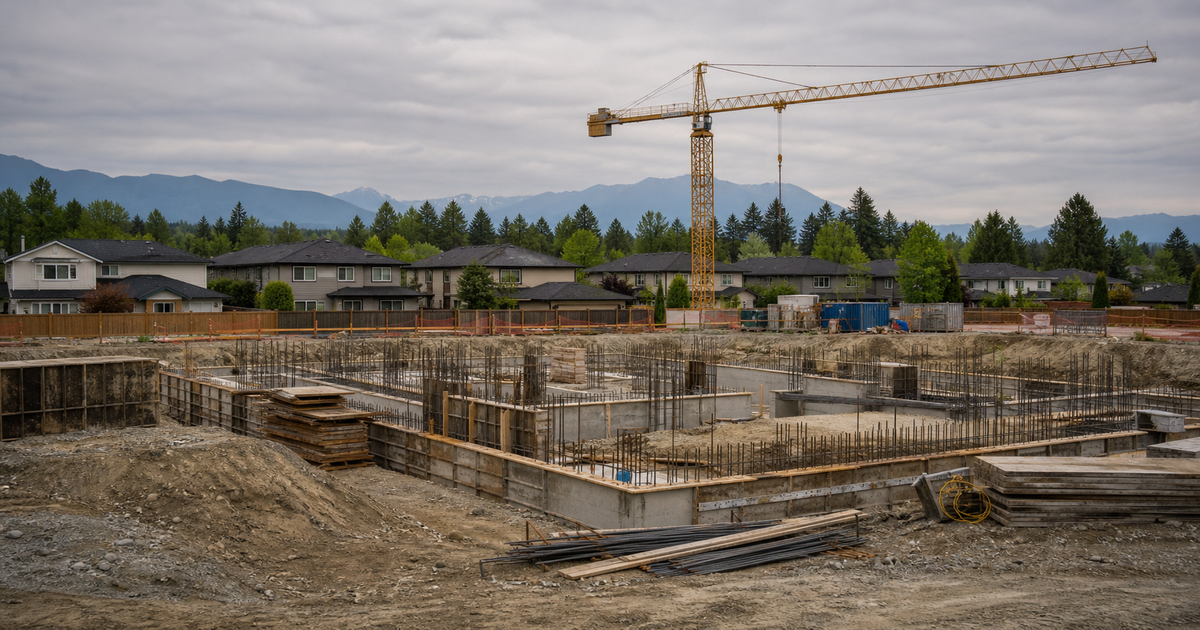
The Condo Conversion Partnership sits across all of this: Build Canada Homes and BC Housing will use "innovative financing tools" to convert more than 2,200 already-built, currently vacant condo units into affordable homes.
The release does not specify the financing tool, the price at which units will be acquired, or the affordability mechanism (rent-geared-to-income, deep subsidy, average-market, below-market purchase). That is a meaningful gap, and we will come back to it.
---
How people are framing this — the two real interpretations
It is worth being honest about both readings. Neither is wrong on the facts; the disagreement is about what the policy will do.
The bullish reading: this is the housing supply shock Canada has needed
The argument: Canada has spent a decade treating housing as a problem of demand — stress-test rules, foreign buyer taxes, mortgage rate holds, GST rebates — while doing almost nothing to expand supply.
The result is the most acute affordability crisis in the G7.
What this package does is attack supply directly: it cuts the largest soft cost (development charges) for multi-unit housing, it converts already-built vacant inventory into occupied homes, and it pairs both with transit investment that lets supply follow demand outward.
For the buyer or rate-watcher who has been waiting for "lower prices," this is not the policy they want.
For the planner, the economist, or the buyer who has accepted that prices will stay high and now cares about how many units come online, this is the right direction.
Every one of the 2,200 condo conversions is a unit that moves from "vacant, contributing to perceived oversupply" to "occupied, contributing to perceived scarcity" — and in BC's structurally tight market, occupied supply removes a unit from the resale stack entirely (because conversions typically lock in below-market rent or ownership structures).
The skeptical reading: this is a condo developer bailout dressed up as affordable housing
The argument: BC's condo market has been soft.
Pre-sale absorption slowed through 2024 and 2025.
Developers who presold towers during the 2021–2022 peak have been sitting on completed units that aren't selling at the prices they need.
Several high-profile projects in Metro Vancouver have converted unsold inventory to purpose-built rental precisely because the rental economics underwritten by CMHC financing work better than the condo-for-sale economics.
The new "Partnership on Condo Conversion" — without published pricing or per-unit subsidy disclosure — looks to skeptics like the federal government stepping in as the buyer of last resort, using public balance-sheet capacity through Build Canada Homes to absorb developer inventory at a price that works for the developer, then re-positioning those units as "affordable" through BC Housing's allocation rules.
That is not necessarily a bad outcome.
It is, however, a different outcome than the press release implies.
If Build Canada Homes pays close to market price for these 2,200 units and then administers them as below-market rentals, the public is effectively subsidizing both the developer (by clearing inventory that would otherwise have been sold at a discount) and the tenant (through the rent gap).
The question — and it is a real one — is whether the per-unit subsidy is disclosed, and whether the developer absorption price was determined through a competitive process or negotiated case-by-case.
A second skeptical note: 2,200 units is not a large number against BC's structural shortfall.
The Canada Mortgage and Housing Corporation (CMHC) has consistently estimated BC needs tens of thousands of additional housing units per year just to restore affordability to 2004 levels by 2030.
2,200 conversions over the program's lifetime is a rounding error against the underlying shortage.
It is symbolically meaningful, financially material to the specific projects involved, and numerically small against the need.
---
The mortgage mechanics: what changes for borrowers
Three direct channels and one indirect channel matter for anyone carrying or shopping for a BC mortgage.
Direct channel one — the rent and supply effect. When 2,200 condo units are removed from the resale-and-rental market and put into an administered affordable-housing pool, the marginal rental vacancy in the surrounding submarket tightens.
This is a short-term price-supportive effect on rents in the specific neighbourhoods where conversions happen (the release specifies "priority growth areas" — likely Vancouver, Surrey, Burnaby, the Tri-Cities, Langford, Kelowna).
For a landlord or a buyer underwriting rental income on a future purchase, that is mildly supportive of cap rates.
For a renter, it is mildly negative — but offset by the fact that the converted units are precisely the units the renter might otherwise have been competing for at market rent.
Direct channel two — DC relief and what it does to new construction mortgages. A 50% DC reduction on multi-unit housing in priority communities, saving up to $40,000 per unit, is paid to the municipality in the form of lower upfront costs at building permit issuance.
That money does not flow to the buyer directly — but it flows into the developer's pro forma, which means the developer can carry a lower pre-sale threshold before starting construction, which means more projects break ground, which means more competitive bidding for trade capacity, which over the medium term should put modest downward pressure on new-build pricing.
For someone taking out a construction mortgage or a high-ratio insured mortgage on a new build, this is the slow-burn supply-side benefit.
Direct channel three — the announcement effect on existing insured mortgages. CMHC-insured mortgages on condo units have had a long-running friction: the "insurable condo" rules require a minimum owner-occupancy rate and a cap on special assessments, and when a building has too many rental or non-owner-occupied units, buyers in that building lose access to the best insured mortgage products.
A wave of "conversion to affordable" can complicate this in two directions: the converted units are removed from the insured mortgage universe entirely (they become BC Housing-administered, not privately mortgaged), and the remaining owner-occupied units in the same building benefit from a higher concentration of insured-eligible neighbours.
For a buyer in a building where some units are being converted, the practical effect is a tighter lending market for the converted units and a slightly easier one for the remaining resale inventory.
The net effect on the building's value is small but directionally positive for the resale inventory.
Indirect channel — transit and the long-term land value curve. The $2.5 billion CPTF line funds Surrey–Langley SkyTrain and frequency improvements on high-traffic corridors.
Historical BC transit corridors (the Millennium Line, the Canada Line, the Evergreen Extension) have produced measurable land-value uplift in the walk-shed of new stations.
For a buyer or refinancer holding a property inside the announced corridor, that is a multi-year tailwind on appraised value.
For a buyer looking at entry-level product, it does not move the needle in the short term.
---
Short-term impact: what to watch in the next 6 to 18 months
The most likely near-term market effects are not the headline numbers. They are the second-order signals.
Pre-sale condo absorption in Metro Vancouver. If the conversion program is meaningfully capitalized, developers who have been holding inventory should see relief, and that should translate into a small uptick in pre-sale activity in the affected submarkets — not because the underlying demand has changed, but because competing inventory has been withdrawn.
Watch for the next round of MLA data from the Real Estate Board of Greater Vancouver (REBGV) and the BCREA.
Purpose-built rental starts. The BCSF DC reduction is the bigger lever. Municipalities have to opt in.
The first municipalities to designate themselves "priority communities" and lower DCs by 50% will see a measurable bump in building permit issuance within 6 to 12 months. This is the line-item most likely to show up in CMHC's Starts and Completions Survey by Q4 2026 or Q1 2027.
Insured mortgage eligibility for existing condo buildings. CMHC and the federally regulated lenders will need to publish guidance on how the conversion program interacts with the existing insurable condo rules. That guidance is what actually moves the lending market for resales in affected buildings. Watch for that, not the press conference.
The legislative transfer. The $284 million transfer is contingent on legislation passing. That is a near-term political variable: the federal government has introduced the bill, but the timing of Royal Assent and the actual flow of funds to BC will determine how much of the 2026 construction season benefits.
---
Long-term impact: what this changes about BC real estate
Over the 10-year window of the package, the structural effects are larger than the headline number suggests.
The DC-reduction model becomes the default for transit-oriented multi-unit housing. Once two or three priority municipalities adopt the 50% DC reduction, the political pressure on the rest of the region to follow is strong.
This is a one-way ratchet: BC's DCs were raised over decades to fund growth-paying-for-growth, and once a municipality has opted out of part of that model with federal-provincial cost-sharing, the case for charging full DCs becomes harder to make.
The likely 10-year trajectory is a partial compression of the soft-cost stack on multi-unit housing across the GVRD and the Capital Regional District.
Conversion becomes a recognized absorption channel. The 2,200-unit program is a proof-of-concept.
If the partnership works — meaning if Build Canada Homes can deploy capital efficiently, if BC Housing can administer the affordability terms, and if the public subsidy per unit is politically defensible — the model is repeatable.
The next downturn in condo completions will see a faster, larger version of the same tool.
For developers, that changes the risk calculus on pre-sale and completion: there is now a federal backstop with a known shape.
The supply gap persists, but the trajectory bends. Even at full execution, the package does not close BC's housing gap.
It bends the trajectory of new supply upward and the trajectory of vacant inventory downward.
For buyers, that means the era of "wait for prices to crash" is not over — but the era of "wait for the government to do nothing about supply" is.
The relevant comparison is not 2021; it is 2017, with a more interventionist policy backdrop.
Mortgage credit conditions remain the binding constraint. None of this changes the Bank of Canada's overnight rate path, the qualifying rate the OSFI B-20 stress test applies, or the insured mortgage rules.
For most BC buyers carrying or applying for a mortgage, the binding constraint on affordability is still the rate and the qualifying ratio.
The federal-provincial supply package helps at the margin; it does not move the dominant variable.

---
What we do not yet know
Three details will determine whether the program delivers on the optimistic reading or the skeptical one, and they have not yet been disclosed.
The per-unit acquisition price. What does Build Canada Homes pay for the converted units? Is it a competitive process, an appraised value, or a negotiated price? Without this, it is impossible to evaluate the developer-subsidy component.
The affordability mechanism. Are the converted units rented at 80% of average market rent? At rent-geared-to-income levels? Are any sold below market, and to whom? The press release does not say.
The geographic distribution. "Priority growth areas" is a defined term under BC's housing legislation, but the specific municipalities and the unit count per municipality will determine where the supply effect actually lands.
Until those three numbers are public, the right read on the announcement is: a directionally important, politically credible, but underspecified supply-side intervention that will materially help a small number of specific projects and modestly help the BC housing market overall. For anyone making a mortgage decision in the next 6 to 18 months, the program's effect is mostly indirect.
For anyone making a 5- to 10-year hold decision, the program's existence is more important than its first iteration's specifics.
---
The bottom line
The Carney–Eby partnership is the largest single federal-provincial housing infrastructure announcement BC has seen in a generation.
It attacks the right problem — supply, soft costs, vacant inventory — and it does so with cost-shared mechanisms that have a chance of surviving a change of government.
It is not a condo bailout in the crude sense (no blanket developer subsidy has been announced), and it is not a transformational housing program in the ambitious sense (2,200 units is small against BC's structural need).
It is a credible, well-targeted, modestly capitalized supply-side intervention that materially affects a few thousand households and incrementally bends the supply curve for everyone else.
For BC mortgages and BC real estate, the practical near-term effects are small but visible: marginal tightening in the rental submarkets where conversions land, marginal easing in the lending environment for resales in the same buildings, and a measurable but modest lift in purpose-built rental starts in the municipalities that opt into the DC reduction.
The long-term effects are larger: a permanent change in the DC model for transit-oriented multi-unit housing, a repeatable federal backstop for condo absorption in future downturns, and a credible federal-provincial cost-sharing template that will outlast the current government.
That is what today's announcement actually is. It is not "the condo bailout." It is the first serious federal supply-side housing program BC has had in a decade, scaled to the political constraints, and it is a meaningful step in the right direction without being a solution to the problem.
---
Pragmatic Post is an independent editorial channel covering Canadian mortgages, housing policy, and real estate. This article is editorial commentary, not financial advice.
Mortgage decisions should be made with a qualified broker based on individual circumstances.
---
Read more on the Pragmatic Post blog
pragmatic.mortgage/news/carney-eby-bc-condo-partnership-2026