

Can my budget handle the payment?
Ask for the payment under each offer, what it includes and how it could change. Keep property taxes, insurance and everyday expenses in your budget.
Mortgage renewal · BC
A mortgage renewal starts a new term—not necessarily a new payoff timeline. Before you sign, compare four things: your payment, remaining amortization, flexibility and switching costs. Staying, switching and refinancing deserve different conversations.
Have your renewal date, balance and lender’s offer handy.

A rate is one number. Your life has more.
Put both offers beside the same balance, payment frequency and remaining amortization. Then ask what changes—not just what the rate is.
Ask for the payment under each offer, what it includes and how it could change. Keep property taxes, insurance and everyday expenses in your budget.
The term is the contract period. Amortization is the repayment timeline. Extending amortization may reduce payments but can increase total interest; compare that trade-off explicitly.
Ask about portability conditions, prepayment privileges and how an early-exit charge would be calculated. A feature on a brochure still has contractual conditions.
Get an itemized estimate and written confirmation of any lender coverage. Ask about discharge, registration, legal, appraisal and administration costs that apply to your transfer.
Sources: FCAC renewal guidance and terms and amortization. Features, costs and approval requirements vary by lender.
Make this about your life
Next conversation: Bring your current payment and a comfortable household budget. Ask to see payment relief and repayment progress separately.
No personal information is collected by this selector. It suggests questions, not a mortgage product or an eligibility decision.
Three choices. Different trade-offs.
Keep your lender and choose a new term. This may be the simplest route when the offer is competitive and the mortgage still fits.
The rate you can actually get, prepayment privileges and whether the lender requires a new review for any changes you request.
Good question“Can you improve this offer, and what changes with the new term?”
Move the existing mortgage at renewal when another lender offers a better overall fit.
Discharge, registration, appraisal and legal costs; which costs the new lender covers; and whether your mortgage qualifies as a straight switch.
Good question“What will I save after all switching costs, with the same amortization?”
Consider refinancing if you need additional funds or want to change the remaining amortization.
Qualification, equity, fees and total interest. A lower monthly payment can come with a longer repayment schedule.
Explore refinancing →Check the payment without losing the bigger picture
“Is it smaller because of the rate—or because I’ll be paying for longer?”
Use this estimate to begin a conversation. To compare offers fairly, keep the balance and remaining amortization the same first. If you then explore a longer repayment timeline, ask for the projected interest and balance remaining over the same comparison period.
Future rates are unknown. No calculator can guarantee the lifetime cost of a mortgage that renews again later.
Open the renewal comparison calculator →Compare your payment
$405 more per month at the same balance and remaining amortization.
Illustrative rates, not offers. Principal and interest only; Canadian semi-annual compounding. Your existing payment may differ. Fees and lender terms are excluded.
Compare the full cost of staying or switching →The rule borrowers often miss
For an eligible uninsured straight switch between federally regulated lenders at renewal, OSFI no longer prescribes its minimum qualifying rate.
The existing stand-alone mortgage must transfer without increasing the loan amount or remaining contractual amortization, subject to the rule’s conditions. The new lender still reviews the application and applies its underwriting requirements.
Adding cash, consolidating debt or extending amortization changes the question. Ask whether your proposal is a straight switch or a refinance before relying on this exception.
Work backward from your renewal date
Confirm the maturity date, projected balance and remaining amortization. Discuss your plans for the home before shopping for a term.
Use the same balance, payment frequency and amortization. Ask about rate-hold periods, fees, restrictions and the option to adjust if rates change before funding.
A switch needs underwriting and closing coordination. Keep your current lender informed and confirm the deadline to avoid an unwanted automatic renewal.
Planning timeline only. Lender deadlines and rate-hold periods vary; contact us promptly if renewal is close.
Make the review useful
A renewal review starts with your statement and your plans—not a promise that switching will always save money.
Tell us if your income, debts or household have changed, whether you may move, and whether you need access to equity. Those answers can matter more than a small rate difference.
Book my renewal reviewSave it. Share it. Bring it to the conversation.
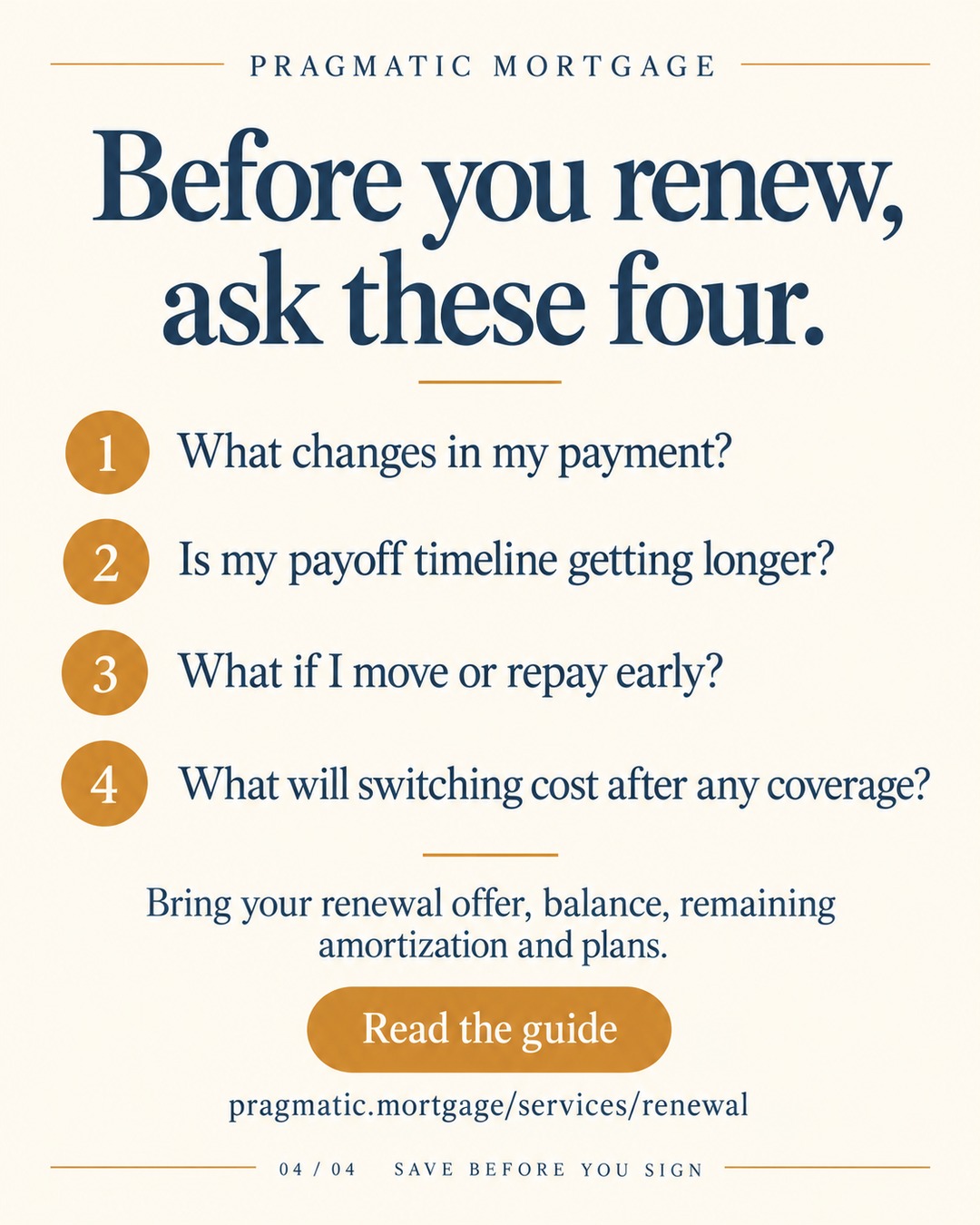
My mortgage renews on [date]. Please compare my options using the same balance and remaining amortization. Show the payment, prepayment and portability conditions, early-exit charge method, and costs I would pay. If an option changes my payoff timeline, please show that separately.
Bring your renewal offer and current statement. Tell us what has changed in your income, debts or plans for the home.
This is a conversation guide, not a recommendation to switch or a promise of savings.
Clear answers
Start comparing a few months before the term ends. Around four months is a useful planning prompt, not a universal lender deadline or guaranteed rate-hold period. If renewal is close, ask promptly what can still be completed before maturity.
A straight switch at maturity can avoid the usual break penalty because you are moving at the end of the term, not breaking mid-term. Legal or registration friction can still matter, so the all-in comparison should include those details.
A switch can involve qualification and lender review even when the balance is not increasing. The exact path depends on your file, the lender, and whether the transfer fits the straight-switch lane cleanly.
For an eligible uninsured straight switch at renewal between federally regulated lenders, OSFI does not prescribe its minimum qualifying rate when the loan amount and amortization do not increase. The receiving lender still underwrites the application. Ask which rules apply to your mortgage, especially if you are adding funds or extending repayment.
Compare the early offer with your existing contract and available alternatives. Ask when the new rate begins, whether there are costs or restrictions, and what happens to your remaining term. An early offer is not automatically better or worse than renewing at maturity.
Renewal starts a new term on an existing mortgage. Adding funds or changing the remaining amortization needs a separate review and may be a refinance. Compare qualification, fees, interest and repayment progress before choosing. A lower payment alone does not establish a lower total cost.
Sources checked September 6, 2026. Lender approval and product eligibility depend on your complete application.
Sources checked September 12, 2026. Prepared by Pragmatic Mortgage Lending. Editorial contact: Dinah Caporusso. Educational information, not a commitment to lend or personal financial advice.
Pragmatic Mortgage Lending · BC
Let’s compare your lender’s offer with the alternatives, including the cost and effort of switching.