

Pragmatic Mortgage Lending | September 8, 2026 | Canadian mortgage analysis
The most expensive mortgage mistake this autumn may not be choosing variable instead of fixed. It may be choosing either one without knowing what happens if rates rise.
The Bank of Canada held its overnight policy rate at 2.25% on September 2.
But a hold is not a promise to stay put.
The Bank flagged greater upside inflation risks, putting a potential increase before year-end firmly on borrowers’ planning radar.
Its remaining scheduled decisions are October 28 and December 9, 2026. Bank of Canada decision; decision calendar.
If your renewal or purchase is approaching, the useful question is not “Can someone guarantee December?” It is: “Would my mortgage still work if December surprises me?”
How likely is an increase by December?
There is credible evidence that markets recently treated a year-end increase as a strong possibility. There is not a dependable, timeless percentage you can plug into a household budget.
In its September 2 analysis, Scotiabank Economics reported that December market pricing incorporated 22 basis points of a 25-basis-point increase.
Under a simplified model with only two outcomes—no change or one quarter-point increase—that corresponds to roughly 88%, or close to nine in ten.
This is our explanation of that pricing, not an official Bank of Canada probability.
Real markets can price multiple outcomes and include risk premiums. Scotiabank’s September 2 report.
Crucially, that is a dated September 2 snapshot—not a verified live September 8 probability, and not a promise of a hike specifically at the December meeting. A move could come earlier, later, or not at all. Forecasts extending into 2027 also should not be mistaken for increases already scheduled for this December.
Since that snapshot, new information has complicated the picture.
Statistics Canada reported on September 4 that employment fell 42,000 in August, unemployment held at 6.4%, and annual wage growth slowed to 2.0% from 2.8%.
That followed employment gains from April through July.
One weaker month does not settle the rate decision, but it is an important counterweight to the inflation story. Statistics Canada’s August Labour Force Survey.
Our assessment: a hike deserves a place in your plan; certainty does not.
What is pushing the risk higher?
1. Energy costs could spread beyond the gas pump
The Bank’s September commentary identifies the Middle East conflict and elevated energy costs as a major concern.
Expensive fuel can raise transport and production costs.
The policy issue is whether a temporary energy shock turns into persistent, broader price pressure.
The Bank said it had not yet seen much evidence of that spillover, but the longer the disruption persists, the greater the risk. Bank of Canada opening statement.
2. Trade barriers can hurt growth and raise costs simultaneously
New US tariffs and Canadian countermeasures complicate the decision. Higher business costs can feed into prices, while disrupted trade can weaken demand.
This is why “bad economic news means cheaper mortgages” is too simple: inflation and growth can pull policy in opposite directions. Bank of Canada September decision.
3. Growth rebounded—but the inflation details still matter
Canada’s economy grew at a 3.3% annualized pace in Q2, partly reflecting temporary factors.
That is not a 3.3% increase in just three months.
Meanwhile, the Bank reported inflation around 3%, driven largely by gasoline; July inflation excluding gasoline was 2.2%, with core measures near 2%.
Those distinctions matter more than a single alarming headline. Bank of Canada September decision.
The next decisions depend on how those forces develop. More persistent inflation would strengthen the case for tightening; easing energy pressure and weaker demand could weaken it. That is scenario analysis, not a forecast of a guaranteed outcome.
A policy hike is not the same thing as your mortgage payment
The Bank’s 2.25% rate is not a consumer mortgage quote. A variable mortgage typically follows the lender’s prime rate plus or minus your contractual spread.
Confirm the lender’s prime-rate changes and effective dates. FCAC’s mortgage-interest guide.
- Adjustable-payment variable: a rate increase generally raises the required payment.
- Fixed-payment variable: your payment may initially stay unchanged while more goes to interest and less to principal. Ask about your trigger rate, trigger point and required corrective action; contract details differ.
- Existing fixed rate: your contracted rate does not change during its term because the Bank changes policy. Renewal brings a new pricing decision.
FCAC’s guide to mortgage terms; FCAC on fixed-payment variable mortgages.
New fixed-rate offers also respond to bond yields, funding costs and lender competition—not only Bank of Canada announcements.
RBC’s renewal explainer notes that fixed pricing is influenced by bond yields and lender expectations.
Waiting for a confirmed policy hike before considering fixed protection can mean shopping after market pricing has already moved.
This is a timing risk, not proof that today’s fixed offer is the cheapest you will see. RBC on renewal timing and fixed rates.
Put a dollar figure on the uncertainty
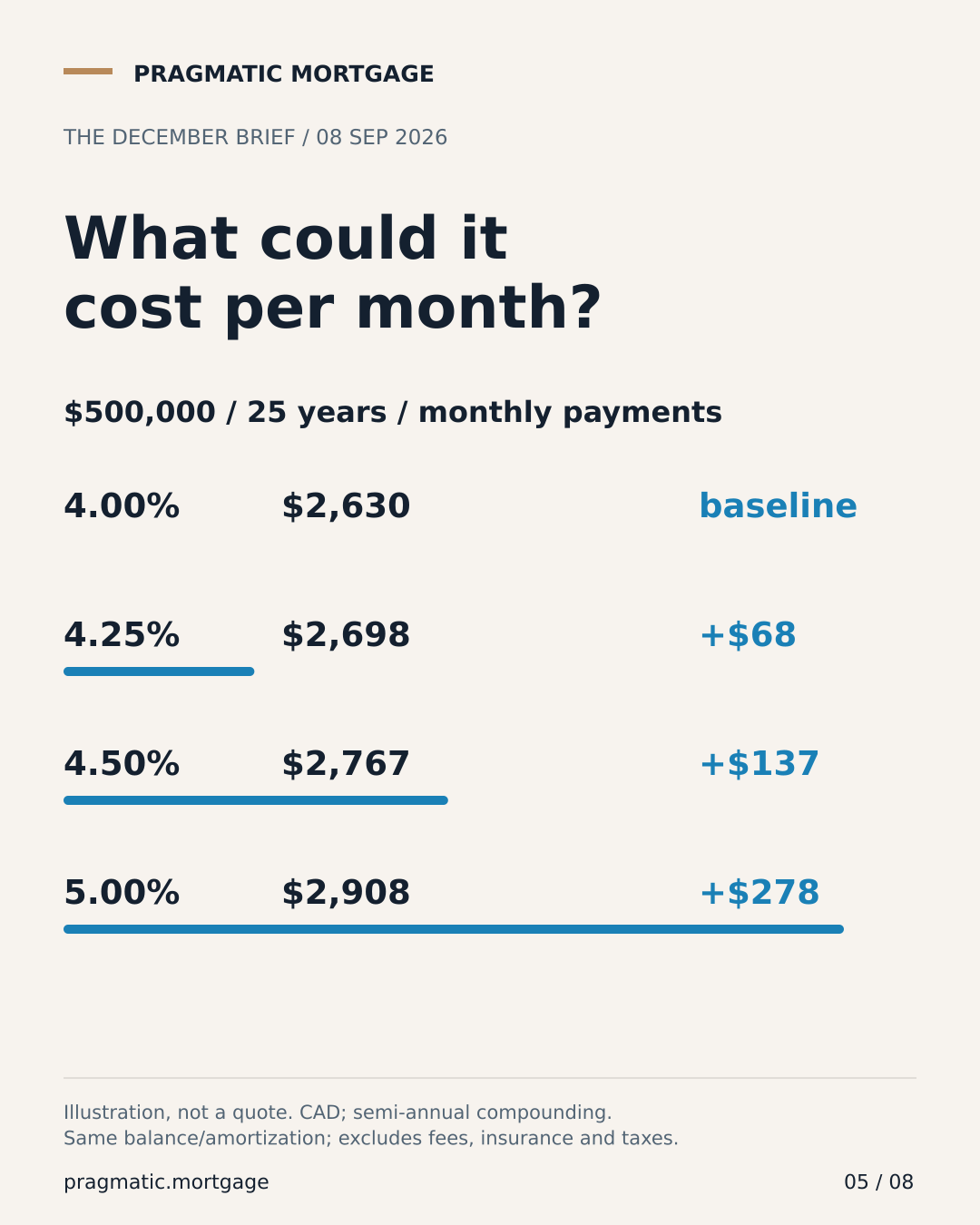
Consider an illustrative $500,000 mortgage with 25 years remaining, monthly payments and a starting annual rate of 4.00%. These are scenarios, not available offers or a prediction of the number of hikes.
| Mortgage rate | Change from starting rate | Monthly payment | Extra per month |
|---|---|---|---|
| 4.00% | No change | $2,630 | — |
| 4.25% | +0.25 percentage points | $2,698 | $68 |
| 4.50% | +0.50 percentage points | $2,767 | $137 |
| 5.00% | +1.00 percentage point | $2,908 | $278 |
Pragmatic Mortgage Lending calculation.
CAD; rounded to nearest dollar.
Each row recalculates payments on the same starting balance and remaining amortization, using nominal annual interest compounded semi-annually.
Actual variable-rate compounding and payment adjustments depend on the contract.
Excludes fees, insurance premiums and property taxes; does not model elapsed time, changing balances or fixed-payment trigger mechanics.
The question is personal: is an additional $68 manageable, and would $278 crowd out essentials or your emergency savings? Use your actual balance, amortization and offer—not this illustration—to make the final decision.
Renewing before year-end? Build options before the deadline
Start with your maturity date, balance and remaining amortization. Request a written renewal offer and compare other lenders; do not treat the first offer as the only one.
FCAC recommends reviewing your needs and shopping around. Federally regulated lenders must generally provide a renewal statement at least 21 days before the term ends, but you can start your comparison earlier. FCAC renewal guide.
Ask each lender or broker
Buying this autumn? Protect the budget, not the headline
A possible increase is a reason to refresh your numbers—not to rush an offer, overbid, or waive financing protection.
Ask for a pre-approval and confirm what it actually protects. A rate hold is conditional, not unconditional approval of you or a property.
Re-run affordability using higher-rate scenarios, property taxes, heating, condo fees where applicable, closing costs and a cash buffer. Choose a purchase ceiling you can live with after closing, not just one you can technically qualify for.
Local inventory, comparable sales, the property’s condition and your expected time in the home still matter. A national rate forecast cannot tell you what a particular Kelowna, Calgary or Vancouver home is worth.
Fixed or variable: choose the risk you can carry
Fixed may fit a household that values payment certainty and has limited room for surprises. Variable may fit someone with a meaningful cash-flow buffer who understands the contract and can tolerate a changing rate. Neither automatically wins because of one forecast.
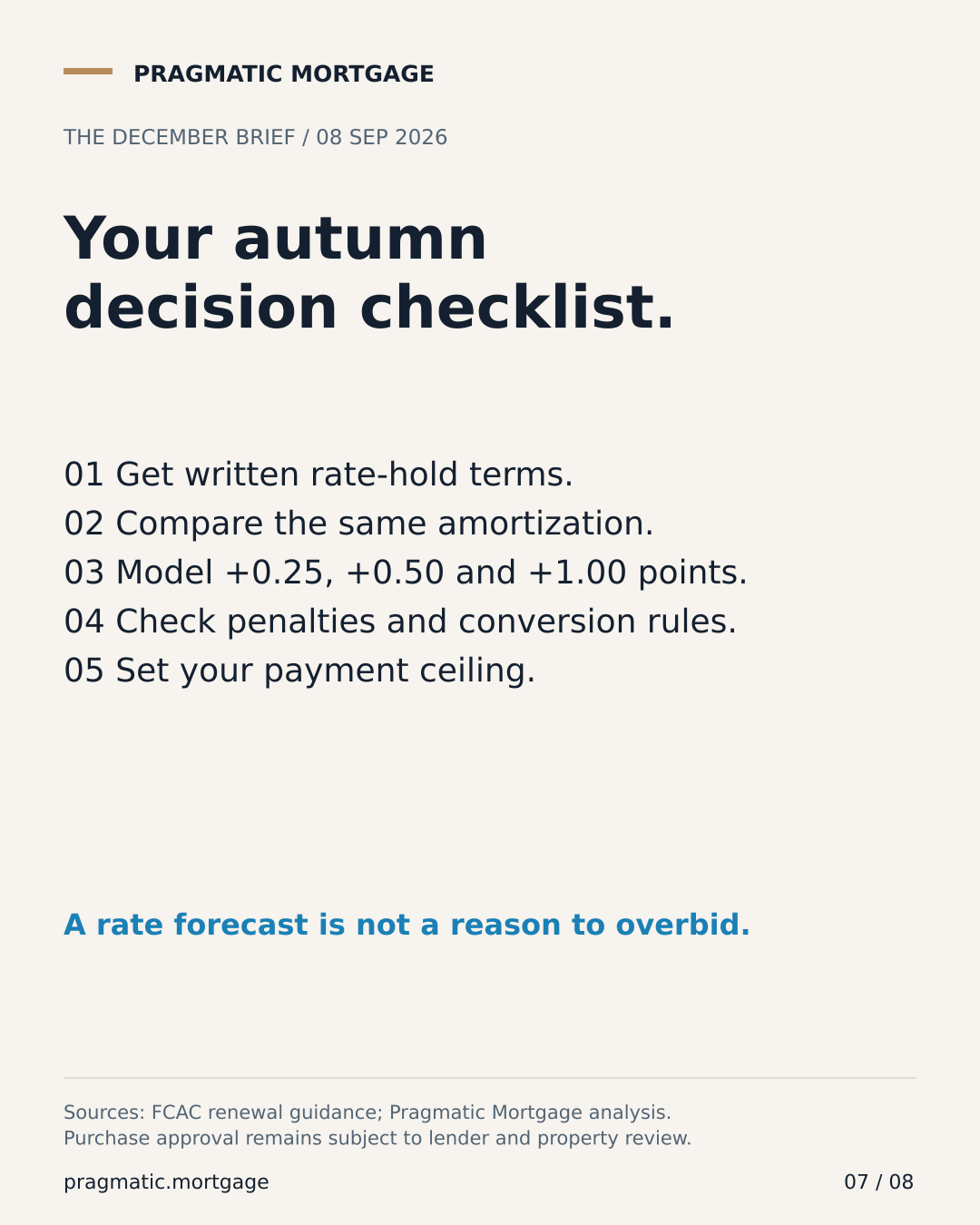
Compare actual offers over several possible rate paths. Include interest, fees, penalties and the possibility of selling or refinancing before the term ends. “I can lock in later” is not free insurance: the future fixed offer and conversion rules may differ from today’s.
You do not need to win a prediction contest. You need a mortgage that still fits if the prediction is wrong.
Compare your options with Pragmatic Mortgage Lending and bring your renewal date or purchase timeline. Ask for a side-by-side fixed-versus-variable review with a payment ceiling you are comfortable carrying.
Educational information, not individualized financial, legal or tax advice. Information checked September 8, 2026; market pricing is explicitly dated September 2.
Rates, forecasts and lender terms can change. Qualification depends on lender criteria and your circumstances.
Cover image: AI-generated illustrative housing scene, not an identified property or documentary photograph.