
Keep the five-year debt
12% · 5-year payoff
$1,112/ month
- Total interest
- $16,733
- Still owing after 5 years
- $0

THE PRAGMATIC GUIDE · BRITISH COLUMBIA
A lower payment can change your month. The payoff date can change your future. Understand both before putting more debt against your home.
See the $50,000 comparison8-minute guide · Sources checked September 11, 2026
Prepared by Pragmatic Mortgage Lending · AI-generated illustrative imagery
FIRST, THE ANSWER
Mortgage debt consolidation replaces debts with borrowing secured against your home. It can reduce the interest rate and simplify payments. But fees and a much longer payoff period can make it cost more overall.
Start with three questions: Can I afford the payment? What will this cost? When will this debt actually be gone? A good plan answers all three.
Relief is a valid goal. If a lower required payment helps you avoid missed payments, that matters. Just call it cash-flow relief—not guaranteed savings. FCAC explains the trade-off ↗
01 · FOLLOW THE MONEY
Here is what happens to a hypothetical $50,000 balance. Move the sliders to see why the repayment period deserves as much attention as the rate.
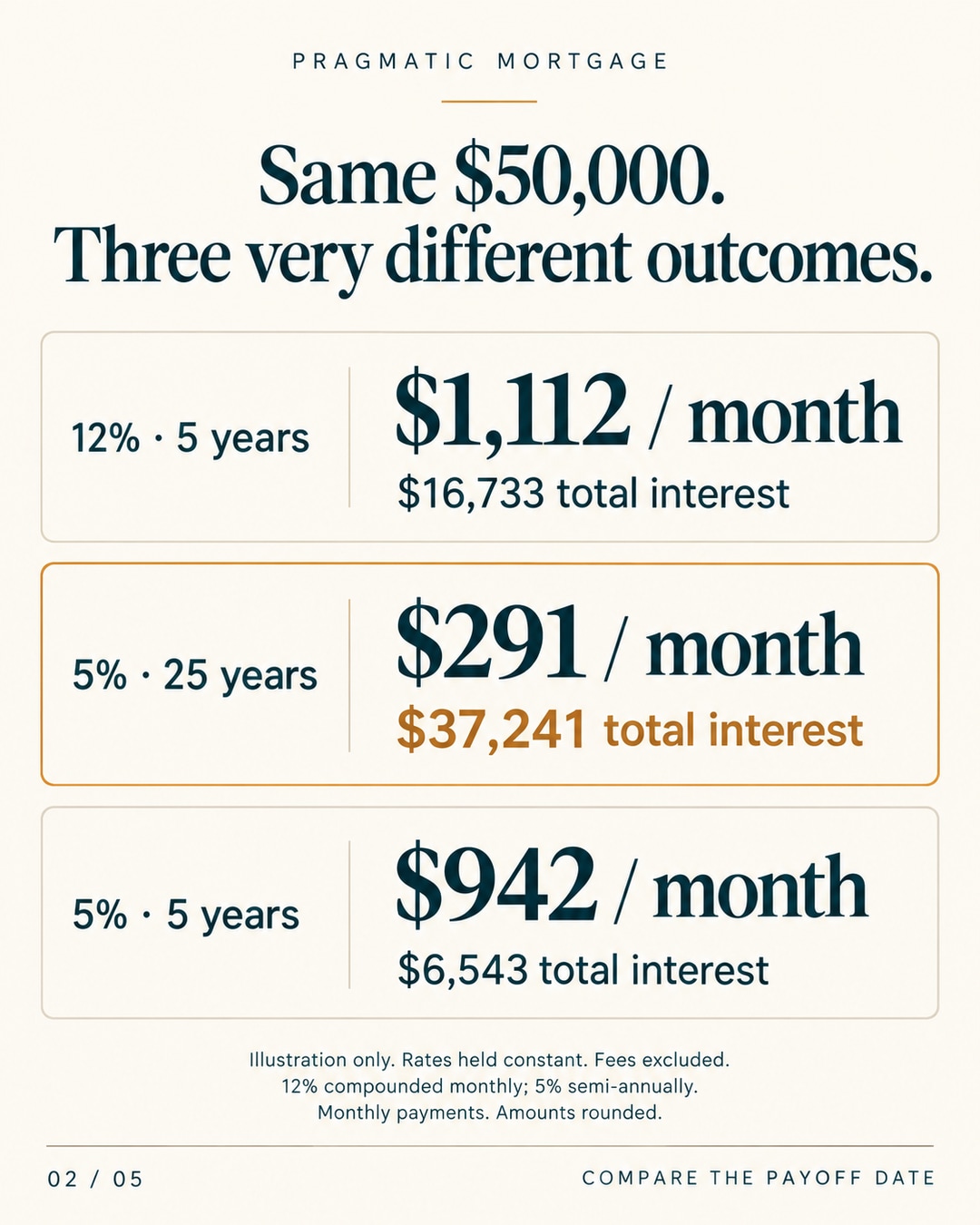
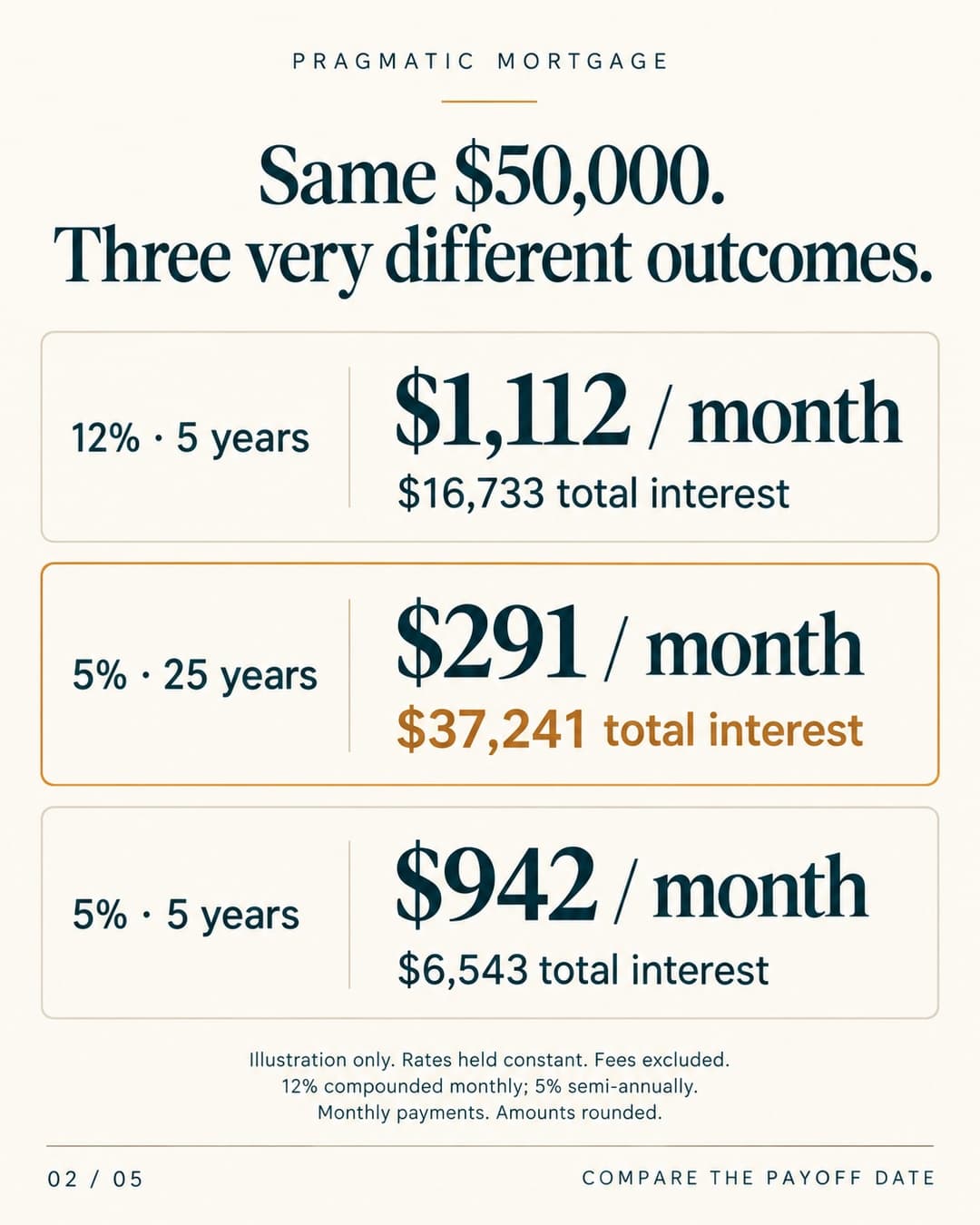
12% · 5-year payoff
5% · 25-year payoff
5% · 5-year payoff
Illustration, not a rate offer or approval. Monthly payments; 12% nominal interest compounded monthly on the starting debt; mortgage rates compounded semi-annually. Rates held constant for the entire payoff period. No fees, new spending or missed payments. Rounded for display; calculations use unrounded payments. Real mortgage rates can change at renewal.
This isolates the debt portion—not your entire mortgage. It excludes the cost of replacing your existing mortgage rate and does not represent a lender-offered separate loan. Use the full refinance analysis before deciding.
At the starting settings, the 25-year option lowers the payment by about $821 a month versus the five-year 12% debt. But after five years, about $44,254 still remains. That is the number the payment alone cannot tell you.
The 25-year total is a constant-rate illustration, not a prediction. A mortgage term and its amortization are different: you may renew several times before the balance reaches zero. Understand term versus amortization ↗
THE SAVEABLE VERSION
Keep the payoff date in the conversation.
These are the starting figures from the interactive example above. Compare them with the same assumptions—not as a mortgage offer. A lower interest rate and a realistic shorter repayment plan can work together; a lower rate alone is not the whole strategy.
Save the comparison image ↗Source: original calculations using our shared Canadian mortgage payment engine. All figures in Canadian dollars.
02 · THE PART A SIMPLE COMPARISON MISSES
Your current mortgage rate may be valuable. Replacing it can change the cost of the entire balance—not just the debt you want to consolidate.
Ask for two complete projections over the same horizon: keep the mortgage and repay the other debts; or refinance the mortgage and include those debts. Show payments, interest, fees and the ending balance for each. Include debts that stay outside the refinance.
A “fees divided by monthly payment reduction” calculation measures cash-flow recovery, not necessarily economic break-even. If the smaller payment also repays principal more slowly, that shortcut can flatter the refinance.
Run the whole-mortgage refinance analysis ↗MAKE ROOM FOR YOUR LIFE
The best plan is not the most aggressive one on paper. It is the one you can sustain without quietly rebuilding the debt.
03 · DESIGN THE EXIT, NOT JUST THE LOAN
Separate the consolidated debt goal from your home’s overall amortization. In the illustration, paying the 5% portion over five years takes about $942 per month, not $291. Ask whether that payment is sustainable.
Confirm permitted amounts, dates and charges. A separately tracked amortizing portion may help where offered. Otherwise, document a payment plan; do not assume the lender will ring-fence the debt for you. Check prepayment rules ↗
Budget for irregular expenses and a buffer. Decide which credit limits you still need and how you will avoid rebuilding balances. There is no benefit in replacing the old debt and then borrowing it back.
Put a three-month check-in on your calendar. Compare the actual balance with the plan, not just whether this month’s payment cleared. If the budget still does not work, revisit the strategy early.
04 · EQUITY IS CAPACITY, NOT PERMISSION
For a typical conventional refinance, use 80% of the appraised value as a planning ceiling for total secured borrowing. Existing mortgages, secured credit and financing costs reduce the room. A HELOC has different limits.
Property value alone does not qualify you. The lender also assesses income, credit, the property and its own rules. Available equity is not a recommendation to use all of it. FCAC’s equity guidance ↗
A starting point, not an approval
Before penalties, fees and any lender adjustments.
Conventional refinance illustration: 80% of value minus existing secured debt. Appraisal, income, credit and lender rules can reduce the amount. A HELOC has different limits.
Test whether refinancing is worth the cost →05 · A MORTGAGE IS ONE OPTION
BEFORE YOUR RENEWAL OR REFINANCE
Bring your mortgage statement, payout quote, debt balances and rates, income documents and household budget. If renewal is approaching, compare before accepting. Adding debt is a borrowing decision, not just a routine renewal.
“Show me the payment, the total cost, and the date this debt is gone.”A question to take to any lender—not a customer testimonial.
Clear answers
Sometimes. Compare the whole refinance, including your existing mortgage, new debt, fees, payment and payoff date. A lower rate can help, but a longer repayment period can erase that benefit. Your home also becomes security for debt that may previously have been unsecured.
Not necessarily. Cash-flow relief is the difference in monthly outgoings; interest savings are a different calculation. Compare interest and fees over the same time horizon, and the balance still owing at the end. A smaller payment can leave you in debt longer.
Ask before the renewal deadline. Adding debt usually means new borrowing and underwriting, not simply accepting a renewal. Compare a refinance at maturity with other options. It may avoid an early-break penalty, but legal, appraisal, discharge or lender fees may still apply.
For a typical conventional refinance, total secured borrowing is generally limited to 80% of the appraised home value. Subtract existing secured debt and financing costs. This is a planning ceiling, not an approval; income, credit, property and lender rules still apply. HELOC limits differ.
Plan extra payments or ask about a separately tracked amortizing portion, where offered. Confirm the lender's prepayment privileges, timing and penalties first. An informal five-year goal does not change the legal terms of a 25-year mortgage.
Contact your creditors early and compare an unsecured repayment plan or independent credit counselling. A Licensed Insolvency Trustee can assess formal debt-relief options when appropriate. You do not have to secure more debt against your home just because equity is available.
SOURCES & METHODOLOGY
Sources checked September 11, 2026. Canadian educational guidance, with mortgage services in BC. Examples are hypothetical, not borrower stories, rate offers or approval promises. Calculations use Pragmatic Mortgage’s shared payment engine, not a full refinance recommendation.
Editorial reviewer: Dinah Caporusso.
Pragmatic Mortgage Lending · BC
Ask us to compare the mortgage, the other debts, the costs and a realistic finish line. If consolidation does not help, we will say so.