


The Bank of Canada’s next decisions are October 28 and December 9. A quarter-point increase is a credible scenario, but it is not settled. Here is the evidence, the dollar impact, and a plan for buyers and renewing homeowners.
Pragmatic Mortgage Lending analysis · Information checked September 22, 2026 · Reviewed by Dinah Caporusso, Mortgage Broker
On September 21, Bank of Canada Governor Tiff Macklem posed the question that matters to anyone with a variable mortgage: will high energy prices fade, or will inflation stay high enough that the Bank has to raise its policy rate?
He did not announce a hike.
He also described trade uncertainty that could slow growth.
Those forces pull the decision in different directions. Read the Governor’s remarks.
That is why a useful mortgage plan needs more than one forecast. If your purchase or renewal is approaching, the decision is not “Can I call the October meeting?” It is “Which mortgage still fits if my rate rises?”
The 30-second answer
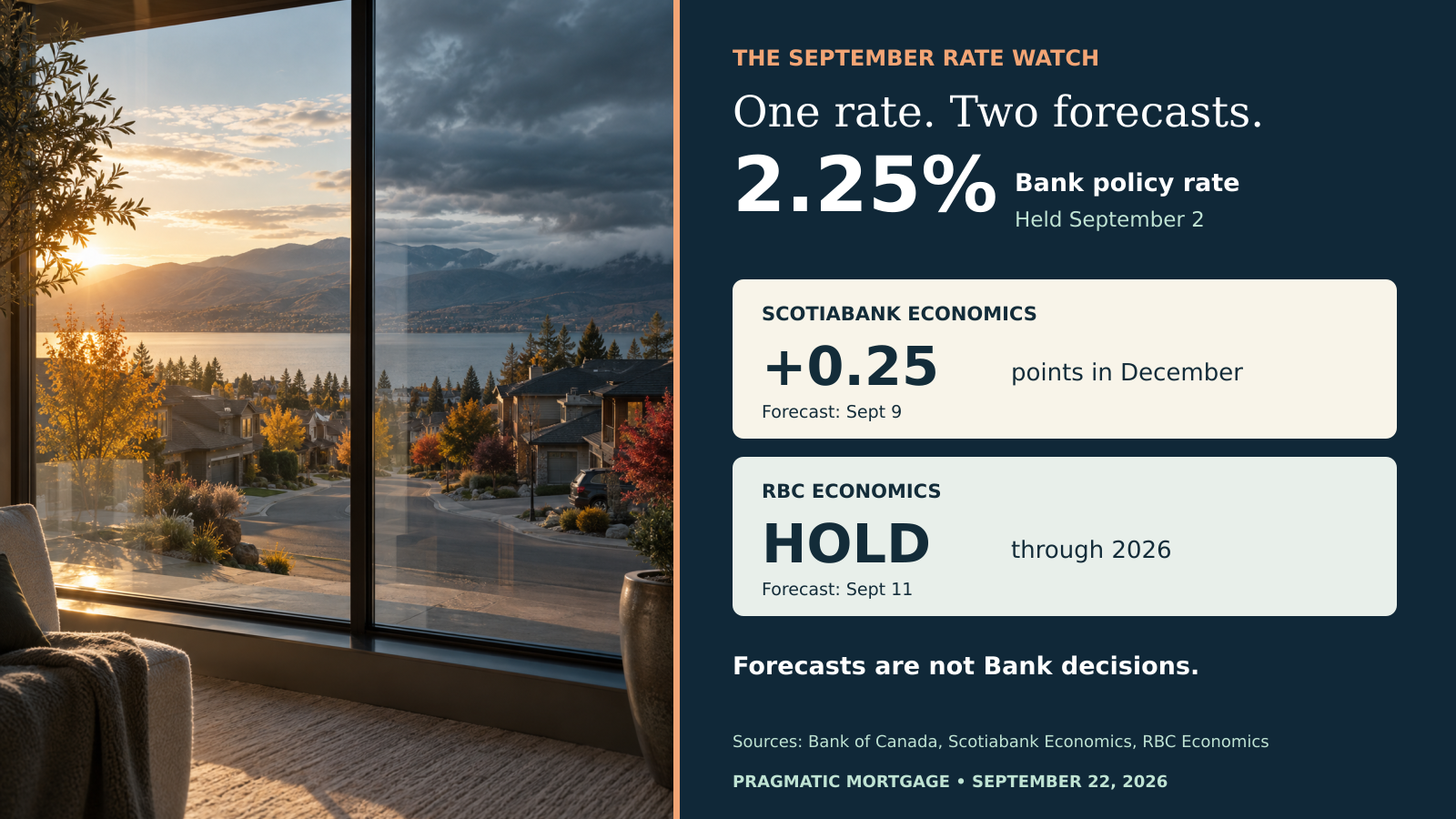
- Where rates stand: The Bank held its overnight target at 2.25% on September 2. The Bank’s published prime-rate series was 4.45% on September 16. Your actual variable mortgage rate is your lender’s prime plus or minus your contractual adjustment—not the Bank’s 2.25% policy rate. Bank decision · Bank rate data · FCAC mortgage guide
- How likely is a rise? It is a credible risk, not a certainty. Scotiabank Economics forecasts a 0.25-percentage-point hike in December and says October is possible but not its base case. RBC Economics expects a hold through 2026, with gradual hikes beginning in 2027; it says the risk has shifted toward an earlier move. Those are dated institutional forecasts, not the Bank’s decision or a numerical probability. Scotiabank, September 9 · RBC, September 11
- How much should you test? Compare no change, +0.25 and +0.50 percentage points. The first increase is the size of Scotiabank’s year-end forecast; the second is a household stress test, not our prediction of two hikes.
- What happens next: September jobs data arrive October 9; September inflation data arrive October 19; the Bank announces its next decision and Monetary Policy Report October 28, then another decision December 9. Statistics Canada · CPI calendar · Bank decision calendar

Why the forecasts split
The headline inflation number is concerning: Canada’s Consumer Price Index rose 3.0% year over year in August.
Fuel remains a major part of the story.
Inflation excluding gasoline was 2.4%; the Bank’s CPI-trim and CPI-median measures were 1.9% and 2.0%.
So the question is not simply whether gas is expensive.
It is whether energy and trade costs start showing up persistently across other goods and services. Statistics Canada’s August CPI release · Bank of Canada data
There is a growth counterweight.
Canada’s August unemployment rate was 6.4%, and employment fell 42,000 that month.
Trade measures can raise some prices while also making businesses less willing to hire and invest.
The Bank has to judge how both sides affect future inflation, not react to a single headline. Statistics Canada’s August labour report · Bank of Canada’s September 2 deliberations
Scotiabank’s case for December
stronger economic momentum and upside inflation risk justify gradually removing monetary stimulus.
Its explicit forecast is one 25-basis-point increase in December. RBC’s case for waiting: core inflation has remained near target, oil pass-through has so far been limited, and the recovery remains vulnerable to trade shocks.
RBC’s base case keeps the policy rate unchanged through this year.
Both can be reasonable readings of the same uncertain evidence; neither can promise your mortgage outcome. Scotiabank forecast · RBC forecast
What a quarter point would mean in dollars
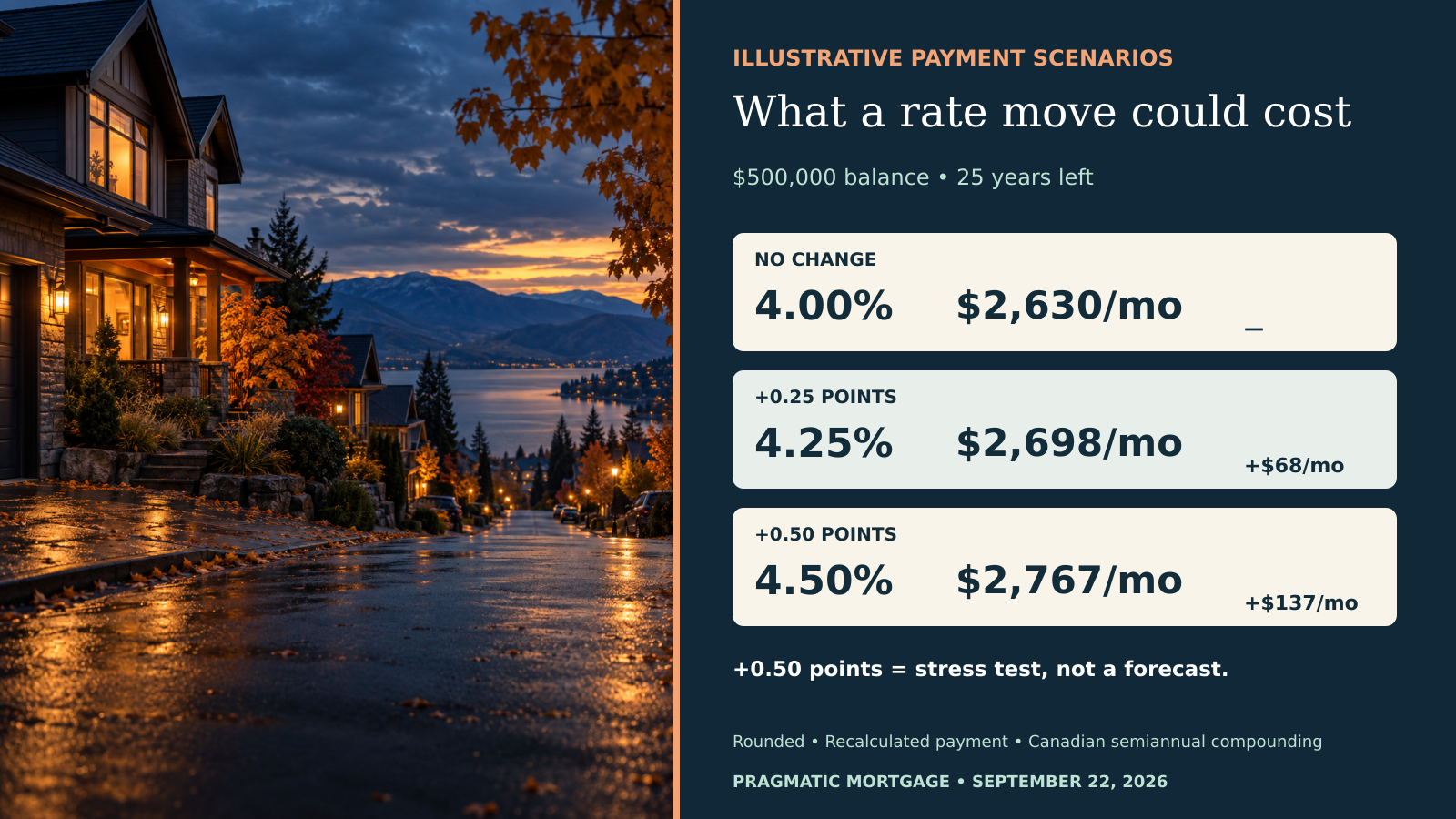
Imagine an illustrative $500,000 mortgage, 25 years remaining, and a 4.00% starting mortgage rate. These are not quoted rates.
If your lender’s prime and your variable rate both rose by the same amount, the recalculated monthly payment would be:
| Scenario | Illustrative mortgage rate | Monthly payment | Change from today |
|---|---|---|---|
| No change | 4.00% | $2,630 | — |
| +0.25 percentage points | 4.25% | $2,698 | +$68/month |
| +0.50 percentage points | 4.50% | $2,767 | +$137/month |
Pragmatic Mortgage Lending calculation, rounded to the nearest dollar.
Each row starts with the same $500,000 balance and 25-year remaining amortization; monthly payment uses a nominal annual Canadian mortgage rate compounded semi-annually.
The illustration assumes an immediate, equal change in the mortgage rate and recalculates the payment.
It excludes taxes, insurance, fees, elapsed time and changes in balance. Your contract can work differently.
Check which kind of variable mortgage you have. With an adjustable payment, the required payment may rise when the lender changes its prime rate.
With a fixed-payment variable mortgage, your payment may initially stay the same while more of it goes to interest and less to principal.
On this sample balance, the first month’s interest would be about $102 higher after a quarter-point rate rise, using the same Canadian compounding assumption.
Your lender may have a trigger rate or require an adjustment later.
The payment table above illustrates a recalculated payment, not a promise that every fixed-payment variable mortgage cheque rises immediately. FCAC explains both structures and trigger points.
The four decisions to make before the Bank decides

What would change our view?
If September inflation shows broader, persistent price pressure, the case for a hike strengthens.
If non-energy inflation remains contained and trade uncertainty or employment weakness deepens, the case for holding strengthens.
The October 28 Monetary Policy Report will explain the Bank’s updated forecast in more detail.
A Bank decision is the event that can change the prime-rate path; a forecast, a bond-yield move or a U.S.
Federal Reserve decision does not mechanically change your Canadian variable mortgage rate. Bank of Canada’s decision calendar · FCAC on prime-linked mortgages
Our read as of September 22
plan for a quarter-point rise before year-end, stay able to handle half a point, and do not pay for certainty you do not need—or take risk your budget cannot carry. The right choice depends on the offers and contract terms available to you.
Bring your renewal date or purchase timeline to Pragmatic Mortgage Lending’s broker team. We can compare actual fixed and variable offers against the payment ceiling you set, including the terms that matter if your plans change.
Educational analysis, not individualized financial advice. Bank decisions, lender prime rates and offers can change after publication.
Cover photography is AI-generated and illustrative, not documentary evidence of a specific property. Source information checked September 22, 2026.