


A smaller mortgage payment can help. The price of the home, your cash reserves and the mortgage contract still decide whether the purchase works.
A mortgage rate drops. You might expect more buyers to jump in. The latest U.S. numbers show how slowly that can happen when housing is still expensive.
For Canadians watching the same headlines, the useful question is what the numbers mean for the home you want and the payment you can carry. There is evidence of softer demand here, too.
There is also a reason to be careful about sweeping claims that every buyer now has the upper hand.
The U.S. headline: what the original data confirms
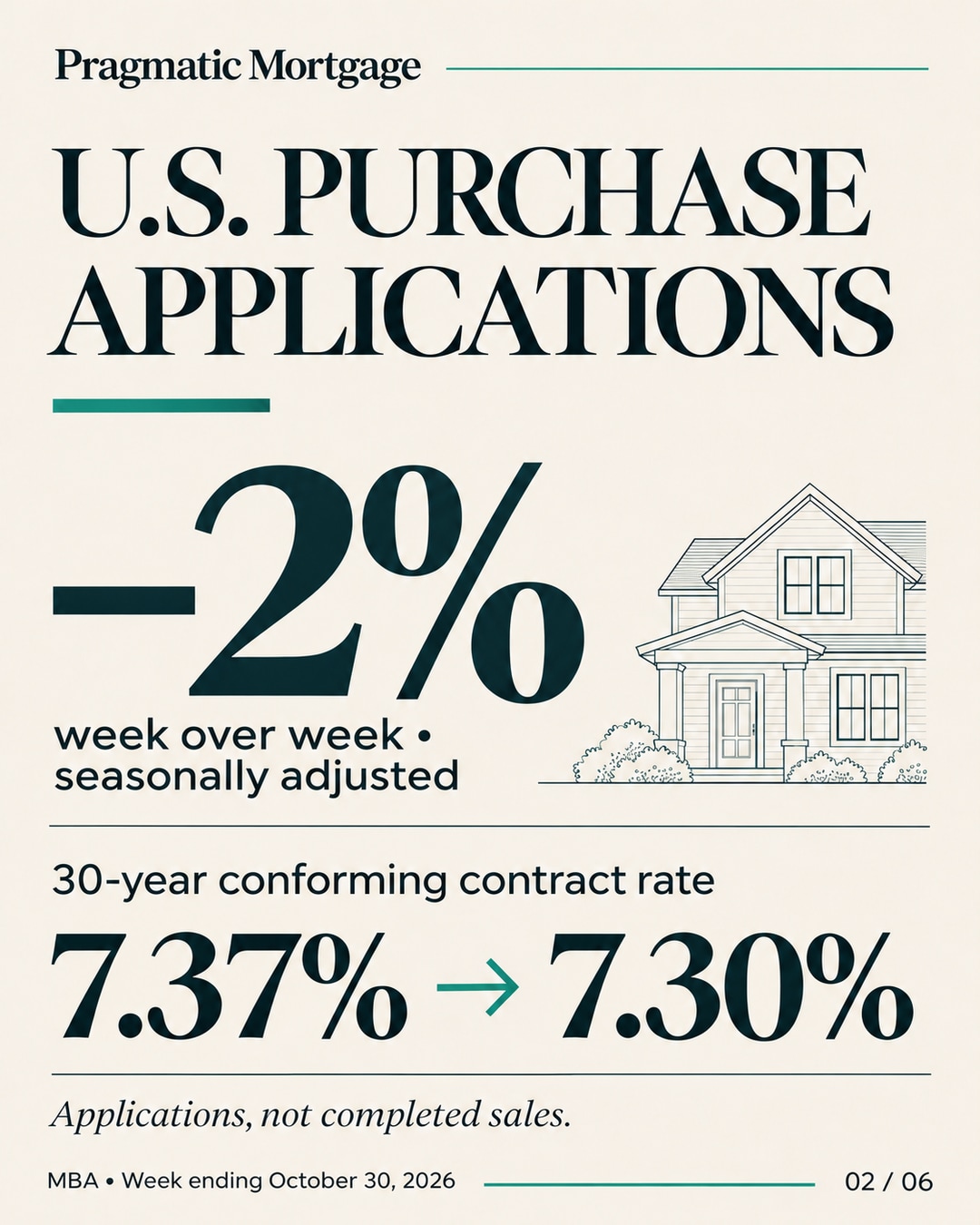
The Mortgage Bankers Association’s November 4 release covers the week ending October 30, 2026:
- Purchase applications, seasonally adjusted: down 2% from the previous week.
- Purchase applications, unadjusted: down 19% from the same week a year earlier.
- Total applications, seasonally adjusted: down 1.2% from the previous week.
- Average 30-year conforming fixed contract rate: 7.30%, down from 7.37%.
That rate improvement was 0.07 percentage points, or seven basis points. Applications measure borrowing activity before a loan closes; they are not a count of completed home purchases. Source: MBA’s dated release.
A check on the viral chart
we verified the weekly direction and changes against MBA’s public release. We could not independently establish its quoted 131 index level or “sixth-lowest since 1995” ranking from that release, so those claims are not used here.
Why a rate dip may leave buyers on the sidelines
A small weekly improvement can leave the overall borrowing cost high.
In a separate survey, Freddie Mac’s November 5 reading was 7.18% for a 30-year fixed mortgage, compared with 6.22% a year earlier.
Its figure differs from MBA’s because the surveys have different coverage and measurement periods.
They should not be spliced into a single rate series. Source: Freddie Mac’s November 5 release and survey description.
There is another obstacle for some existing U.S. homeowners: moving can mean exchanging an older, cheaper mortgage for a more expensive one.
Research hosted by the Bank of Canada discusses this “lock-in” effect alongside the difference between long U.S. fixed-rate contracts and Canada’s shorter terms.
It helps explain why a modest improvement may do little to encourage a move.
It does not prove what caused every household’s decision in this particular week. Source: mortgage-contract research, updated March 2026.
For a new buyer, the obstacles may be more immediate: the down payment, the full housing bill, or confidence in keeping up the payments. A weekly survey cannot tell us the weight of each factor.
Canada has softer sales, but a different yardstick
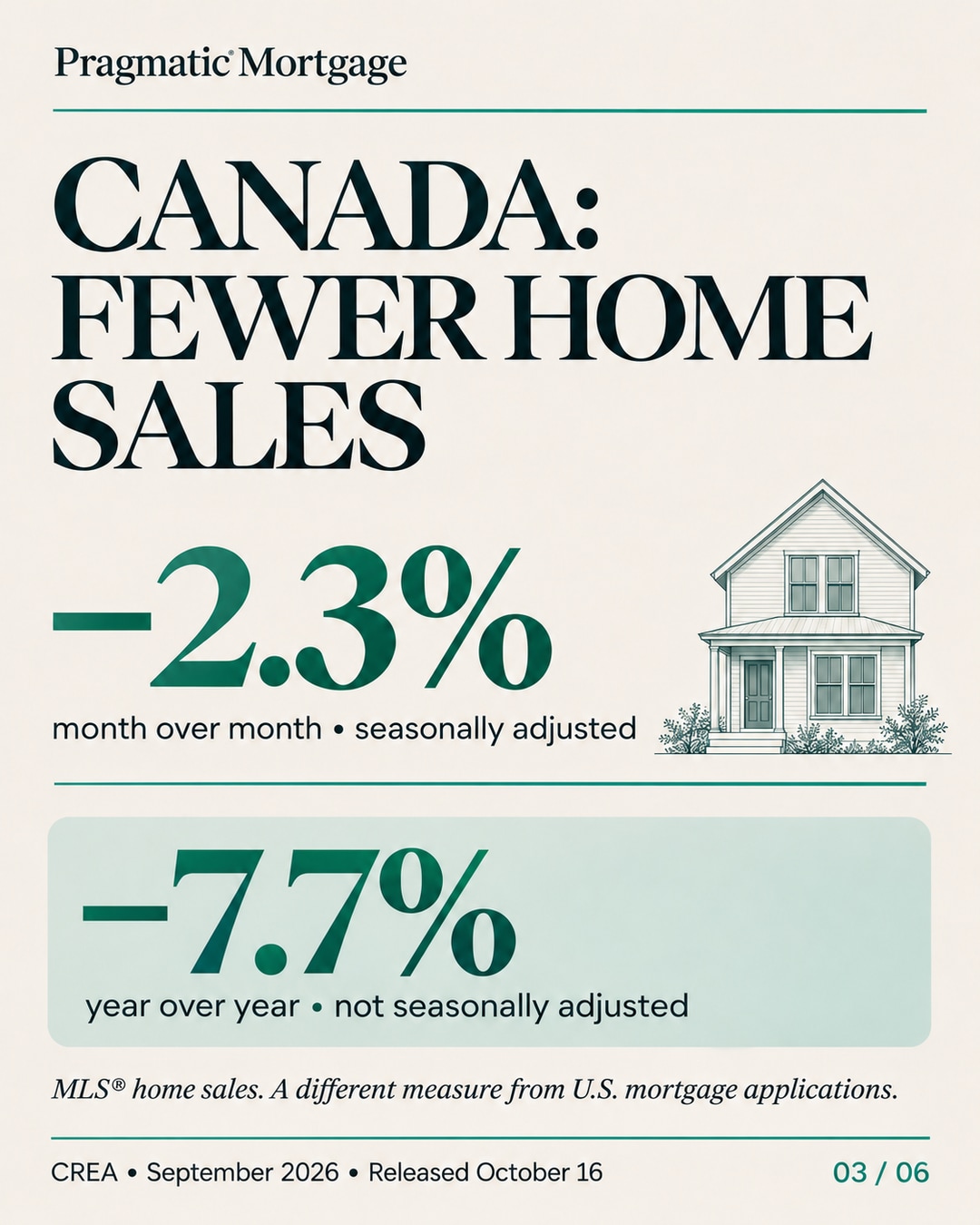
The latest national CREA release available for this article covers September 2026, published October 16. It reports:
- National MLS® home sales, seasonally adjusted: down 2.3% from August.
- Actual national home sales, unadjusted: down 7.7% from September 2025.
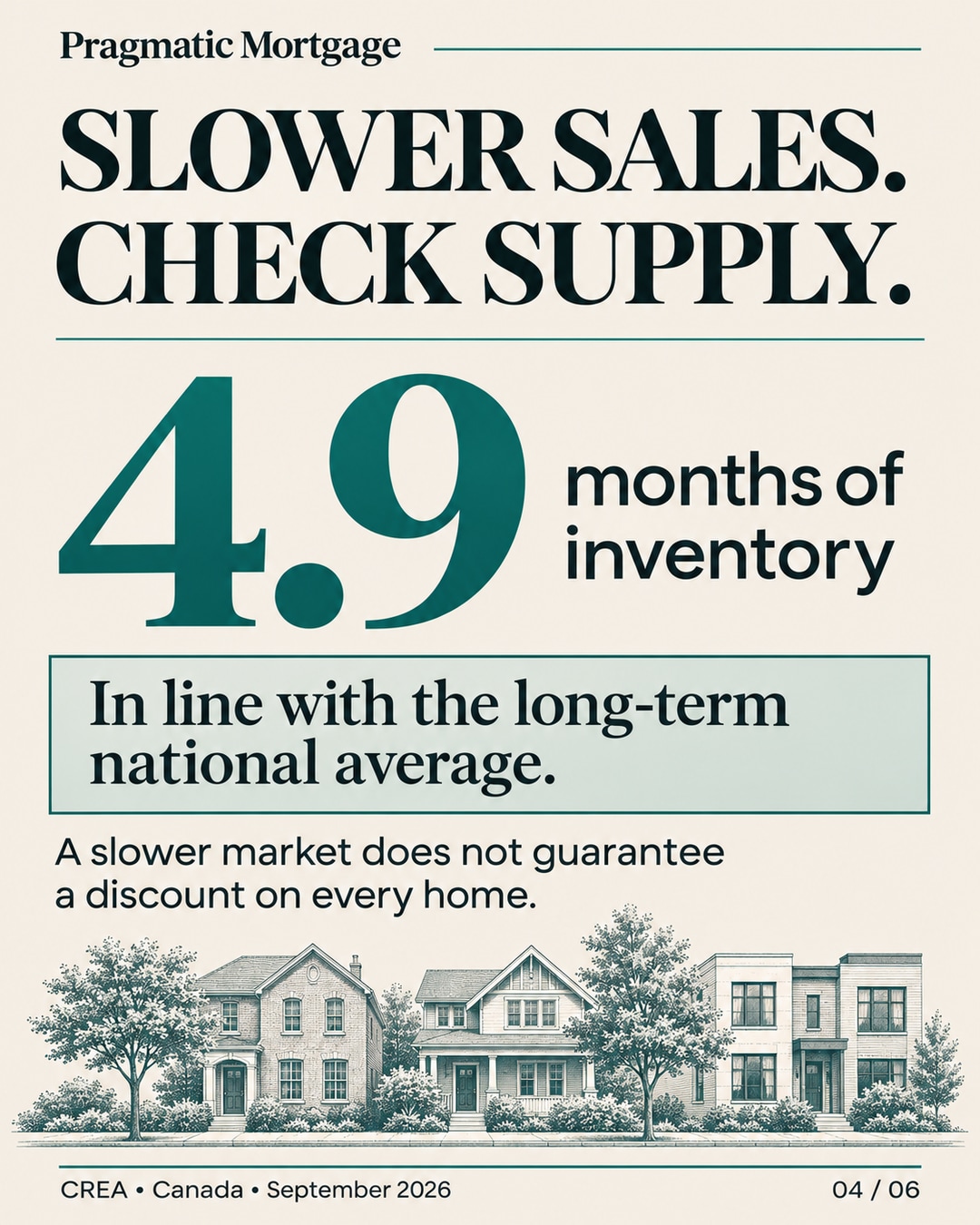
- National months of inventory: 4.9 months.
These are recorded home sales and inventory measures, rather than a Canadian equivalent of MBA’s weekly application index.
The percentages describe different periods and activities.
They do not establish that one country’s market is falling a particular amount faster than the other.
CREA’s next national package is scheduled for November 17, so September data should not be described as November sales. Source: CREA’s October 16 release.
For B.C., BCREA recorded 5,254 residential sales in September, down 8.9% year over year. That is a provincial sales comparison, not an application count or a Kelowna-specific result. Source: BCREA’s October 14 release.
Slower sales can create room to negotiate. Check the supply, too.
CREA describes September’s 4.9 months of national inventory as consistent with its long-term average. Fewer sales alone do not establish an across-the-board buyer’s market. Source: CREA.
For the property you are considering, ask your REALTOR® for recent comparable sales, competing listings and price reductions in the same neighbourhood and property type. A home with several close substitutes can present a different negotiating opportunity from a scarce property attracting multiple serious buyers.
Treat the national data as context. Base an offer on the local evidence and your financing.
Put a rate change into dollars before making a decision
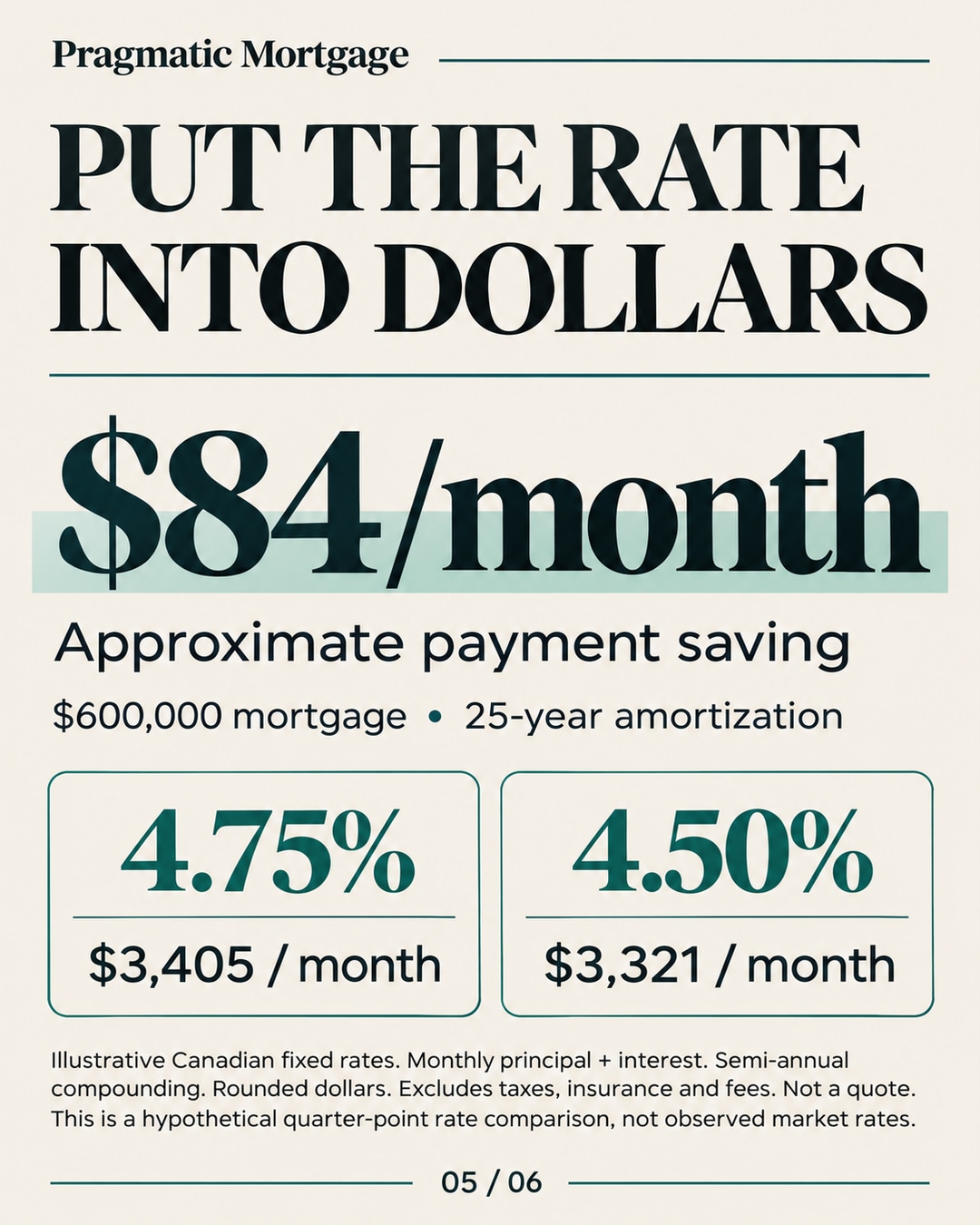
Here is a Canadian fixed-rate illustration, using a $600,000 mortgage, 25-year amortization, monthly payments and nominal rates compounded semi-annually:
- At 4.75%: about $3,405 a month.
- At 4.50%: about $3,321 a month.
- Approximate payment difference: $84 a month.
These are hypothetical rates, not current offers. This quarter-point example is larger than the seven-basis-point weekly change in MBA’s U.S. release.
It excludes property tax, insurance, strata fees, maintenance and other costs. Payments are rounded to the nearest dollar; this compares payments, not total interest costs.
The calculation uses a monthly rate of (1 + annual rate / 2)^(1/6) − 1 over 300 payments.
For a household close to its limit, $84 can matter. It still needs to be weighed alongside the purchase price, savings left after closing and the chance that future renewal payments will differ. A hoped-for rate reduction is a weak foundation for a purchase that is already too tight.
A practical plan for buyers and renewing borrowers
If you are buying
establish a payment you can carry with room for the rest of your life, then confirm your qualification and closing cash. Compare the negotiated price and mortgage together.
Ask your lender what a rate hold covers, when it expires and what still has to be approved for the property and borrower. Use our payment calculator and closing-cost guide to prepare the conversation.
If you are renewing
compare offers before the deadline rather than waiting for a U.S. headline to decide your next term. Canada’s mortgage term and amortization are different: a mortgage can have many years left to repay while its current contract is ending.
FCAC recommends shopping around a few months before renewal and checking costs when switching lenders. Source: FCAC’s renewal guide.
For either decision
compare prepayment privileges, potential break costs and the flexibility you may need if you move. A slightly lower rate can come with a contract that suits your plans less well.
Pragmatic Mortgage Lending helps B.C. borrowers compare the numbers for their own purchase or renewal. Bring us the price, down payment, debts and timing, and we can help you assess a workable financing plan, subject to lender approval.
Quick answers
Does a drop in mortgage applications mean house prices will fall?
It shows weaker application activity for the measured period. Prices also depend on supply, the local market and the homes being sold. It does not establish a particular future price change.
Is Canada’s sales decline directly comparable with the U.S. applications decline?
No. One is a monthly measure of recorded home sales; the other is a weekly mortgage-application measure. Their periods, populations and seasonal adjustments must stay attached to the figures.
Should I wait for a lower mortgage rate?
Compare an affordable plan today with clearly labelled scenarios for waiting. Include rent, savings, possible price changes and the risk that rates rise instead. A forecast cannot guarantee the home, rate or approval available later.
Data checked November 8, 2026. This article uses dated releases rather than live rate quotes.
Calculations and decision examples are illustrative.
General education, not individualized mortgage advice or an offer of credit.
Pragmatic Mortgage Lending provides brokerage services in British Columbia.
Generated neighbourhood scenes are conceptual editorial illustrations, not photographs of actual listings or clients.