
The equity cushion is real. So are the pressures on household budgets. Here is how to read the numbers without mistaking reassurance for a guarantee.
Prepared October 26, 2026 · Pragmatic Mortgage Lending editorial
A home can lose value while its owner keeps paying comfortably. Another owner can have substantial equity and struggle to make the next payment.
That distinction explains why a reassuring U.S. housing statistic deserves a closer look in Canada.
The short version
negative equity remains uncommon in the latest U.S. report verified for this article. Canada’s available public evidence shows low bank mortgage arrears alongside regional housing weakness.
These are different measurements. Neither tells you, by itself, whether your own mortgage is comfortable or whether home prices will rise next year.
First, put the “2.2% underwater” figure on the right date
The 2.2% figure is real: Cotality, a property data and analytics company, reported it for U.S. mortgaged residential properties in Q3 2025, in a release dated December 11, 2025.
Its newer release, published September 10, 2026, reports 2.1% underwater in Q2 2026.
These figures describe homes carrying mortgage debt, not all houses in the country. Cotality: Q3 2025; Cotality: Q2 2026.
A 2.2% figure circulating on social media may therefore be accurate for an older period without being the latest reading. The original social post has not been independently verified.
This article uses dated primary sources and does not attribute that post to a news outlet or call it a new October 2026 measurement.
What “underwater” actually means
Negative equity occurs when the debts secured against a home exceed its estimated current value.
Illustration in Canadian dollars
a home worth $600,000 with $630,000 of mortgage debt has negative equity of $30,000, before selling costs. Include a second mortgage or outstanding home-secured line of credit when assessing your own position.
That is a balance-sheet problem. Arrears are a payment problem: falling behind on what you owe. A household can experience one, both or neither.
There is also a separate issue called negative amortization, where unpaid interest is added to the loan balance. It describes how the debt changes, not whether the home is worth less than the debt. FCAC: mortgage relief options.
Equity creates options. It may let an owner sell and repay the debt or qualify for different financing. It is not the same as cash in a chequing account, and an appraisal does not guarantee a sale price.

Canada: three useful readings, with their limits attached
We did not find a current, directly comparable national Canadian underwater-mortgage percentage in the public Bank of Canada, CMHC, OSFI and CBA material checked for this article. We will not manufacture one or substitute an average loan-to-value ratio for a count of underwater borrowers.
| Indicator | Latest reading verified here | What it measures |
|---|---|---|
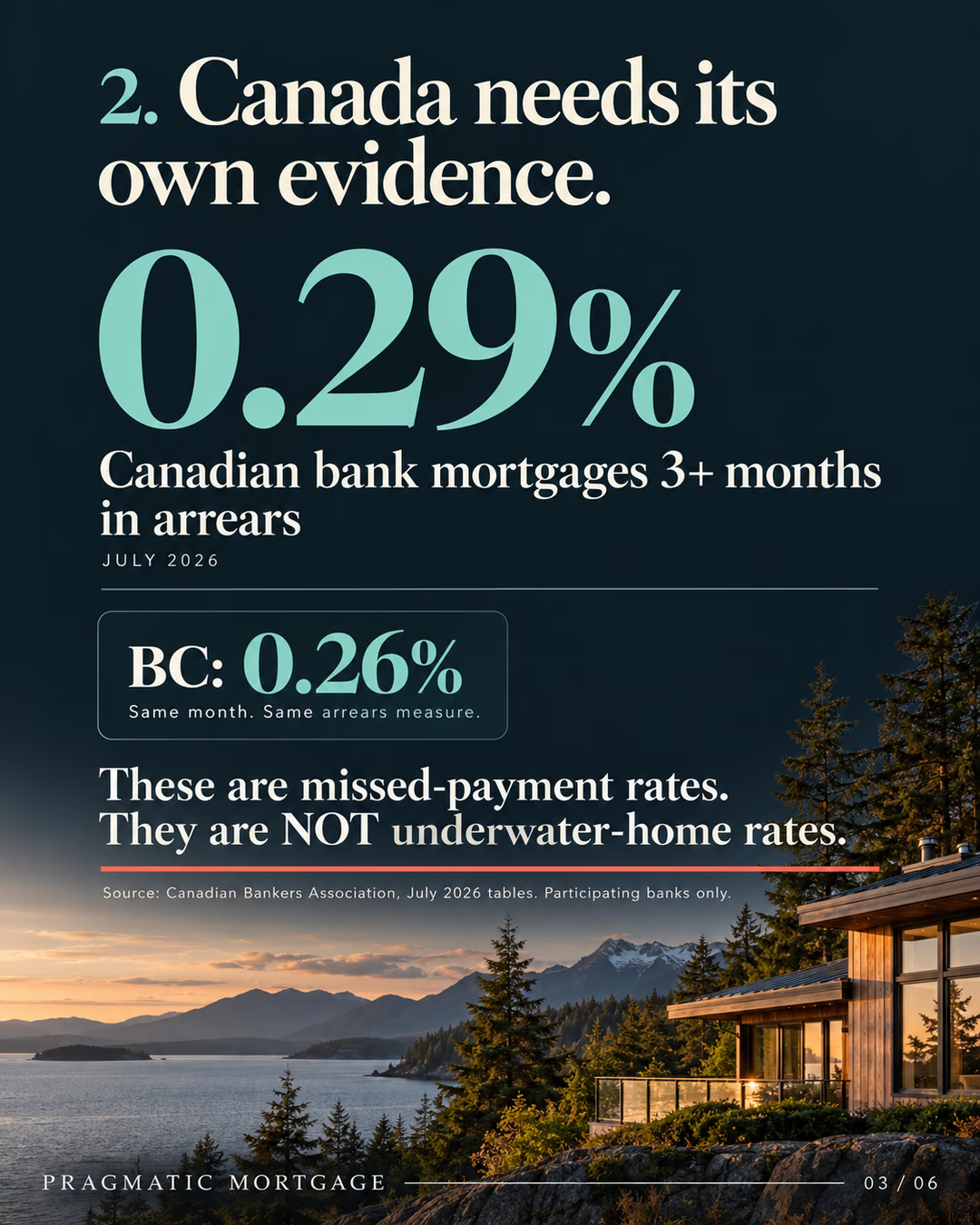
| Canadian bank mortgage arrears | 0.29%, July 2026 | Payments overdue by three months or more at participating banks |
| British Columbia bank mortgage arrears | 0.26%, July 2026 | The same payment measure for BC, including Yukon in the source tables |
| National Composite MLS® Home Price Index | Down 3.4% year over year, September 2026 | Price movement for benchmark homes, not the share of owners with negative equity |
Sources: CBA July 2026 tables; CREA’s October 16, 2026 release.
Do not compare Canada’s 0.29% with the U.S.
2.1% as if they rank the same risk. One measures missed payments; the other measures debt relative to property value.
CBA’s series covers participating banks, rather than the full Canadian mortgage market.
CMHC explains why bank, insurer and credit-bureau datasets produce different arrears readings. CMHC: understanding mortgage arrears.
The national price index is not a valuation of your property either. A condominium, detached home and rural property can move differently, even within one province.
How does this compare with the 2008 subprime crisis?
The scale of U.S. negative equity was dramatically greater in the aftermath of that crisis. CoreLogic reported 23.1% of U.S. mortgaged residential properties underwater at the end of 2010, compared with Cotality’s 2.1% in Q2 2026.
The older figure is an aftermath reading, not a 2008 reading.
Historical coverage, valuation models and revisions mean this is a scale comparison, not a perfectly matched experiment. CoreLogic’s March 2011 release.
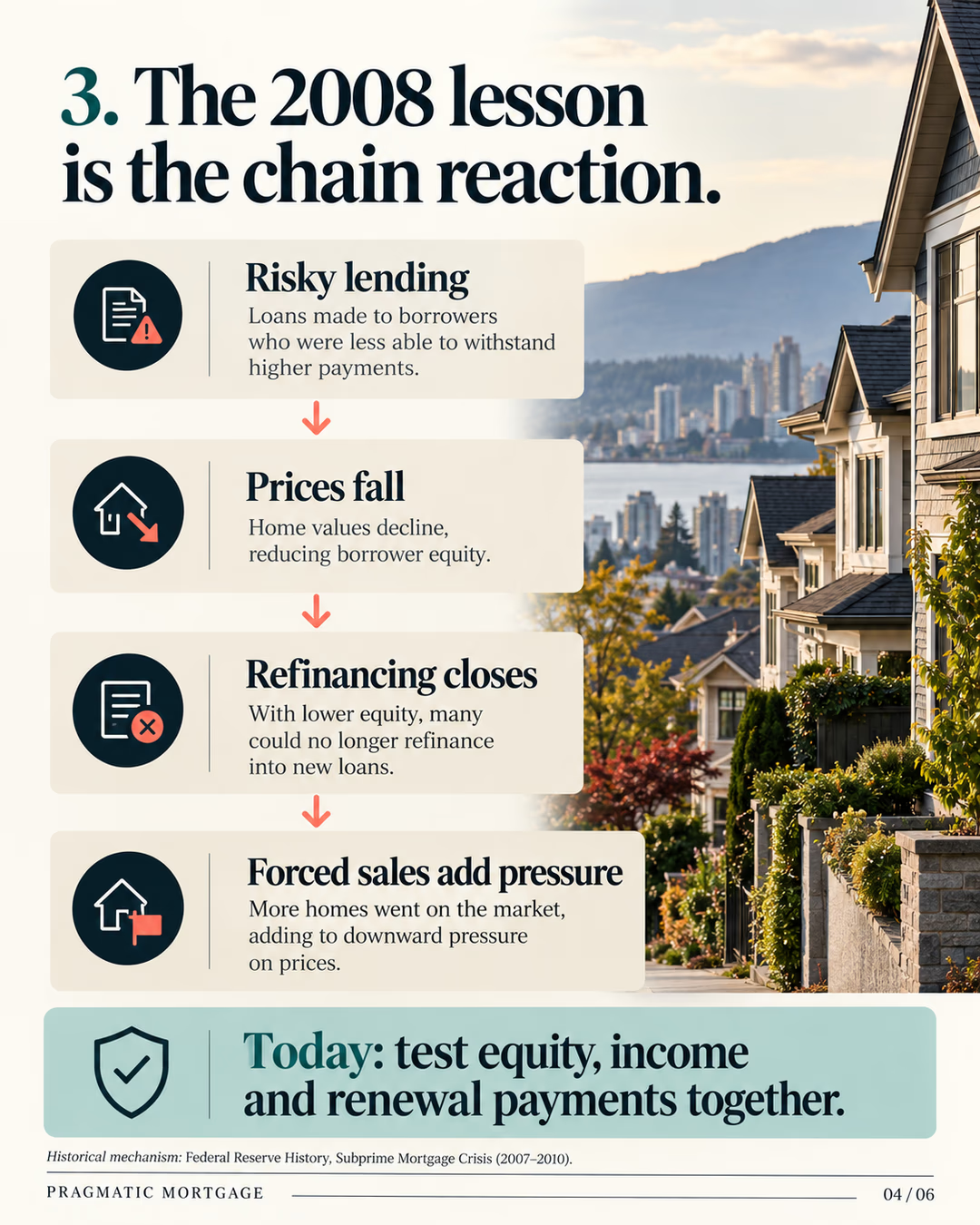
The crisis involved more than falling prices. Risky lending and mortgage-backed securities helped spread losses.
When borrowers could no longer refinance or sell for enough to repay their loans, distress intensified. Forced sales put further pressure on prices and credit availability. Federal Reserve History: the subprime mortgage crisis.
Lending safeguards have changed since then.
The U.S. ability-to-repay framework generally requires lenders to assess and document repayment capacity.
In Canada, OSFI’s qualifying rate for most newly underwritten uninsured mortgages at federally regulated lenders is the greater of the contract rate plus two percentage points or 5.25%.
Eligible uninsured straight switches at renewal have an exception; lender approval is still required. CFPB: ability-to-repay; OSFI: qualifying rate.
Those safeguards reduce particular risks. They cannot prevent unemployment, guarantee property values or ensure every household can absorb a payment increase.
Canada’s particular pressure point: the next mortgage term
Canadian mortgages commonly require renewal before the loan is fully repaid. A rate that worked at purchase can become a different budget at renewal. FCAC: renewing your mortgage.
In its May 2026 Financial Stability Report, the Bank of Canada found households broadly resilient, but highlighted vulnerability among highly indebted borrowers and pressure in Toronto and Vancouver condominium markets.
Its renewal analysis projected an average payment increase of about 15% for the remaining pandemic-era five-year fixed-payment cohort renewing over the following 12 months.
That cohort represented about 12% of outstanding mortgages. This was a dated, group-specific projection, not the expected increase for every borrower today. Bank of Canada: 2026 household assessment.
Here is why even a modest price move matters to a recent buyer
| Simplified example | At purchase | After a 5% value decline |
|---|---|---|
| Property value | $700,000 | $665,000 |
| Mortgage, held constant for illustration | $665,000 | $665,000 |
| Equity | $35,000 | $0 |
This calculation deliberately ignores principal repayments, financed insurance premiums, fees and selling costs. Actual results will differ. It illustrates leverage: a 5% price decline can consume an initial 5% equity cushion. It does not forecast a price decline.

The outlook: watch the combination, not one headline
Our assessment
the verified evidence does not establish a repeat of the U.S. subprime crisis. It does justify careful planning, especially where a thin equity cushion overlaps with an upcoming payment increase or unstable income.
CREA’s September data show renewed price softness. OSFI’s 2026–27 risk outlook identifies renewal exposure and employment-related risks.
These support a cautious, local approach rather than a national crash call. CREA; OSFI’s risk outlook.
Consider three possible paths, not assigned probabilities:
- Stabilization: incomes and payments remain manageable and local prices settle. Owners can gradually rebuild equity through repayment.
- Prolonged squeeze: homes take longer to sell and payments remain demanding. Owners may need more cash flexibility even without widespread defaults.
- Adverse shock: job losses coincide with weaker prices and tighter financing. Households with little equity and little liquid savings have fewer exits.
The warning sign is the overlap of risks. A price decline alone is different from a price decline combined with lost income and a need to sell immediately.
What should you do before buying, renewing or refinancing?
Renewing
start several months ahead. Gather the remaining balance, maturity date, amortization and current payment.
Compare the proposed payment, penalties and flexibility, not just the interest rate. Switching and increasing your mortgage are different transactions with different qualification requirements. FCAC renewal guidance.
Buying
keep money available after closing. Model mortgage payments alongside strata fees, property taxes, insurance and repairs.
Consider the cost of selling sooner than planned. Buying only works if the household budget works; a reassuring U.S. equity statistic cannot make that decision for you.
Refinancing or selling
obtain a realistic valuation and add every debt secured on the property. Include selling costs and any mortgage discharge or prepayment costs when estimating sale proceeds.
Conventional home-equity borrowing is generally limited to a portion of the property’s value and remains subject to approval. Positive equity does not automatically mean you can access it. FCAC: borrowing against home equity.
Already stretched
contact your lender before missing a payment. Ask what relief is available and what it would cost over time. A longer amortization can lower a payment while increasing total interest. FCAC: relief options.
Your three-number check
For a BC property, Pragmatic Mortgage Lending can help you compare mortgage scenarios and explain the tradeoffs. Explore renewal planning, refinancing or our mortgage calculators.
Quick answers
Does being underwater mean foreclosure is automatic? No. Negative equity and missed payments are different conditions. Your contract and circumstances matter. Get advice early if payments are becoming difficult.
Is Canada’s underwater rate 0.29%? No. That is July 2026’s participating-bank mortgage arrears rate. It is not a negative-equity measure.
Can a headline predict my home’s price? No. National averages and models cannot establish a specific property’s market value or future sale price.
Does mortgage default insurance protect my down payment? No. Default insurance protects the lender against specified losses from borrower default; it is not a guarantee of the borrower’s equity. OSFI: mortgage insurance.
Evidence checked October 26, 2026. Data periods are labelled separately from publication dates.
Forecasts are conditional, and figures may be revised.
Images are AI-generated editorial illustrations, not photographs of identified homes or evidence of market conditions.
General education only; not personalized financial, legal or investment advice. Brokerage services are offered for BC properties, subject to eligibility and approval.