
Real-Time Rail launched November 9. Here is what changes for your money, who is connected, and what to check before you send a payment.
It is Sunday night. You want to move money between accounts, pay a supplier or make sure the rent has arrived. The balance on your screen is useful. Knowing the payment has actually settled is better.
Canada’s new Real-Time Rail (RTR) is built to make eligible payments settle around the clock. Payments Canada announced its launch on November 9, 2026.
The important detail: a national network going live and your bank releasing a service are two separate events. Read the launch announcement.
The 30-second explanation
Think of RTR as the infrastructure connecting payment providers. You use a service offered by your bank or financial app; that provider uses the network to move the money.
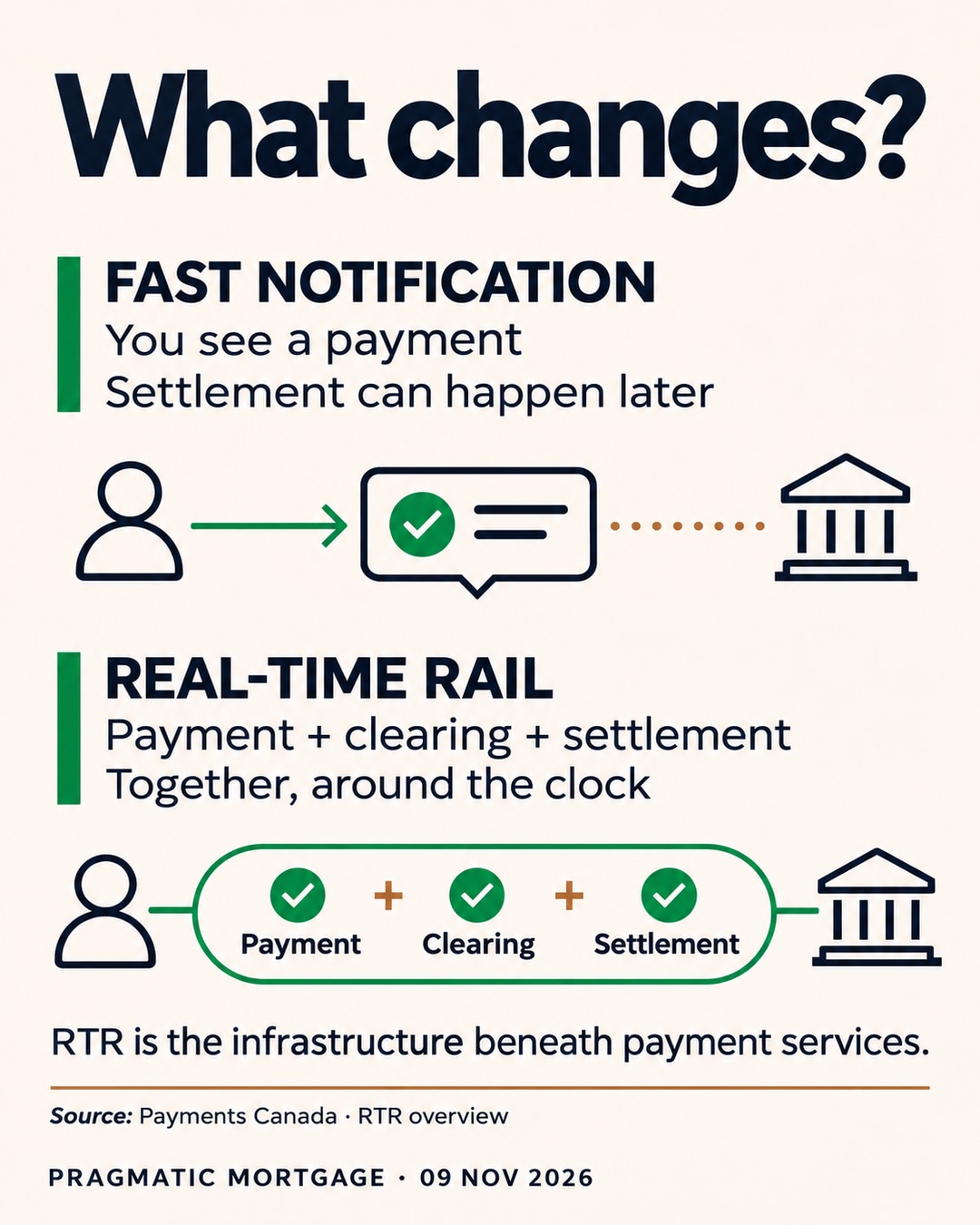
With RTR, the payment message, clearing and settlement can happen in real time, 24 hours a day, including weekends and holidays. In ordinary language, settlement is the point at which the payment obligation between participating institutions is completed. Payments Canada’s overview.
This matters because a fast notification and final settlement are different things. A payment can look immediate to a customer while the institutions settle later. RTR brings those steps together. Payments Canada explains the distinction.
Which banks and providers are connected now?
Payments Canada names eight active system participants at launch:
- Wealthsimple
- Questbank
- Peoples Trust Company
- Paramount Commerce
- KOHO
- DoBusiness.com
- Digital Commerce Bank
- Bank of America
This is the operator’s launch list, not a list of eight identical consumer banking products. The Canadian Big Six—RBC, TD, BMO, Scotiabank, CIBC and National Bank—are absent from that initial active-participant list. Source: November 9 launch release.
KOHO
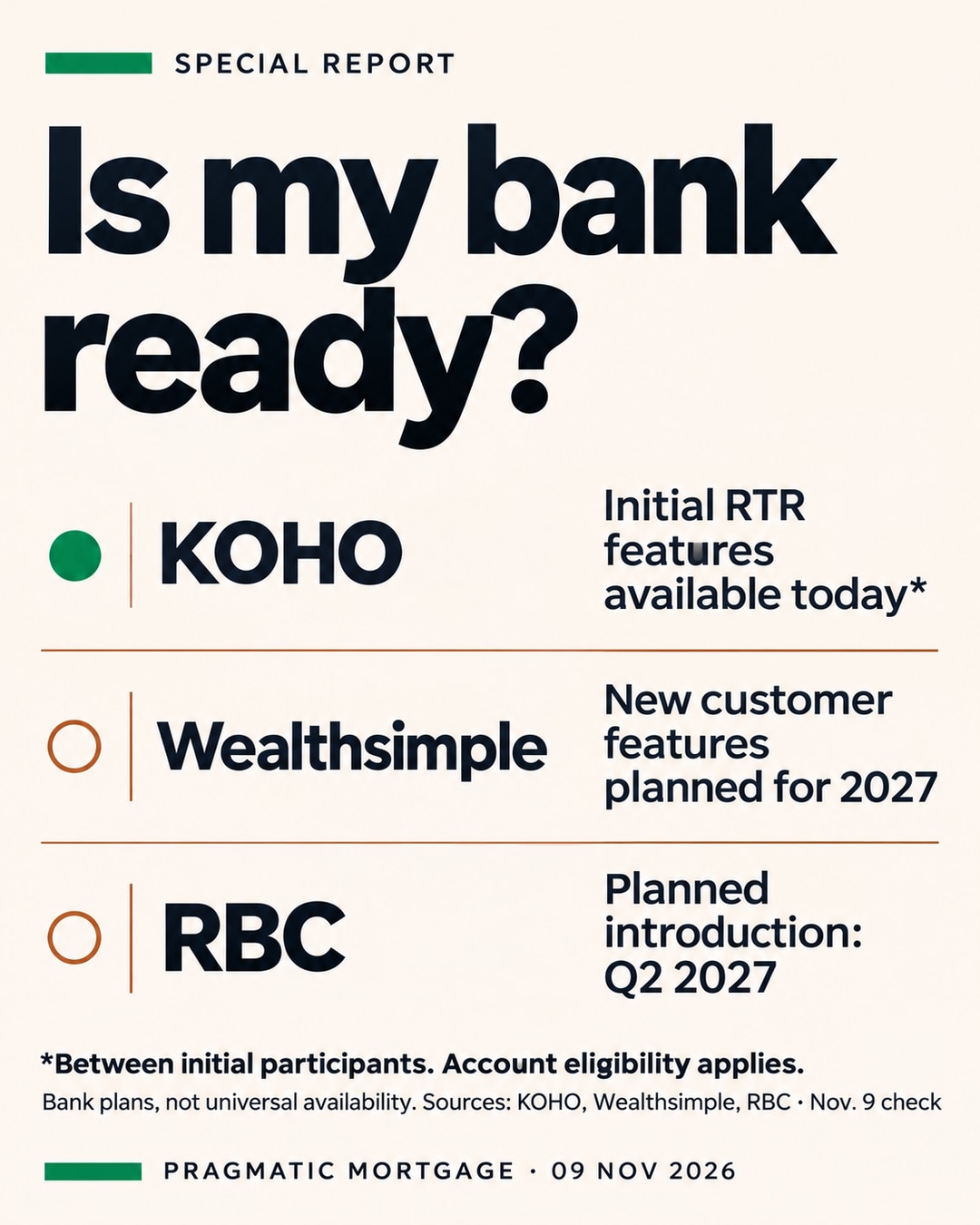
its November 9 announcement says initial capabilities are available in its app between the first participants. Confirm your account’s eligibility and the destination before assuming a particular transfer qualifies. KOHO’s company announcement.
Wealthsimple
it has joined the network, but says it is testing capabilities and plans new instant-payment features in 2027. Participation today does not mean every client transfer becomes instant today. Wealthsimple’s announcement.
RBC
its published business explainer says it is scheduled to introduce RTR in Q2 2027—April through June.
That is a stated plan, rather than a guarantee that every RBC account and payment type will be eligible on the first day of that quarter.
We did not establish individual customer launch dates for TD, BMO, Scotiabank, CIBC or National Bank from the sources checked. RBC’s rollout explanation.
What happens next? A timeline you can actually use
Payments Canada’s target rollout sequence is:
- Q4 2026: the network launches with initial participants.
- Q1 2027: the first participants migrate Interac e-Transfer clearing and settlement.
- Q2 2027: more e-Transfer migration participants follow.
- Q3 2027: participants in the initial launch phases reach full transaction volumes.
These are network rollout targets. Your provider still determines which services you can use and when. Payments Canada’s testing and launch timeline.
Payments Canada separately targets serving more than nine in 10 Canadian bank accounts by Q3 2027. That measures intended reach, not the share of payments already travelling over RTR. The operator’s November 9 update.
The questions Canadians are asking today
Launch-day discussions in r/canada, r/Wealthsimple and r/PersonalFinanceCanada show understandable confusion about e-Transfers, fees, missing banks and bill payments. Those discussions helped shape these questions; the answers below rely on the operator and providers, not commenters’ predictions.
Isn’t Interac e-Transfer already fast?
Often the customer experience is fast. RTR adds real-time clearing and settlement underneath payment services.
Payments Canada’s migration timeline shows that e-Transfer and RTR can work together. You do not need to treat them as competing apps or assume that e-Transfer disappears. RTR’s official rollout sequence.
Can I send $100,000 now?
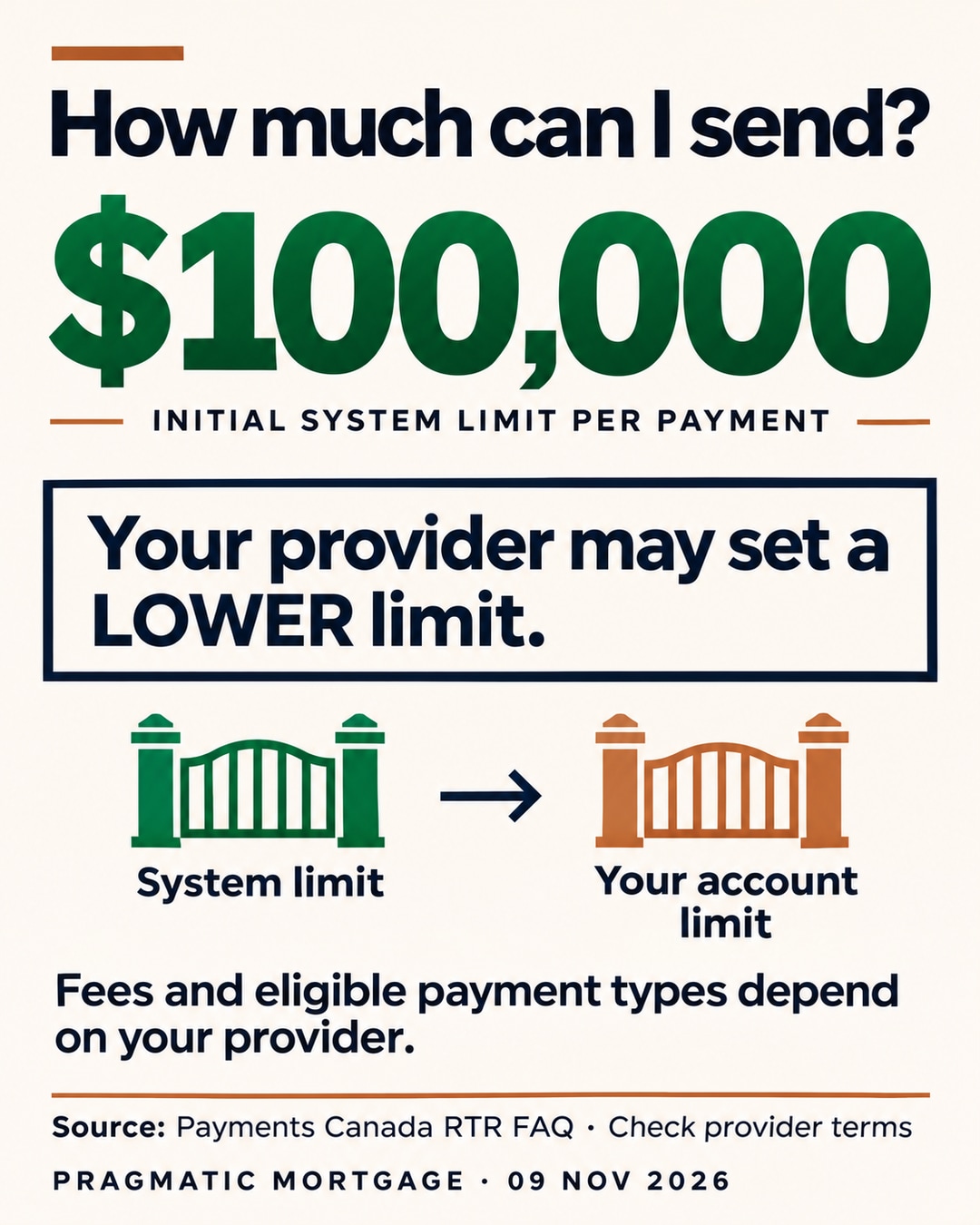
$100,000 is the initial system limit per payment. Your provider can impose a lower limit. Both ends must support the network. It is not permission to send that amount from every account today. Payments Canada’s FAQ.
Will it be free? Do I need another app?
The network launch does not establish one retail price or a universal consumer app. Services are offered commercially by providers.
Check the service name, eligible accounts, sending and receiving fees, limits and supported destinations in your provider’s official terms. A lower infrastructure cost is not a promise that every customer transfer will be free.
Will paying my credit card update its balance instantly?
Do not assume so. Moving the money and a biller updating its own account records are separate steps.
Confirm the supported payment route and the biller’s posting policy. Keep the existing deadline buffer until both providers explicitly confirm a faster process.
The same care applies to utilities and tax bills: a possible use case is not proof of a live service on your account.
Can I cancel a payment or recover money sent to a scammer?
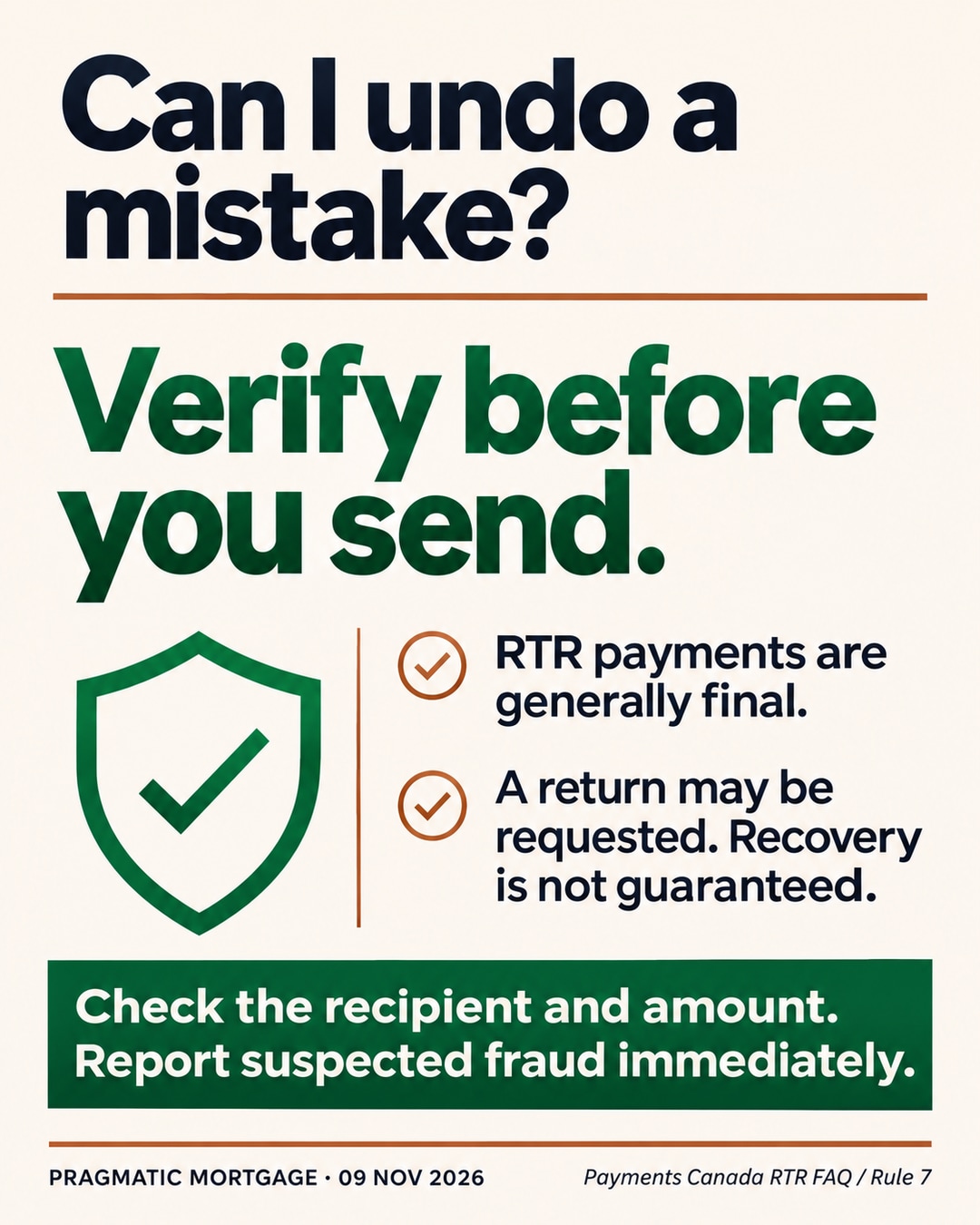
Payments are generally final. A provider may request a return under the rules, but getting the money back is not guaranteed. Contact your provider immediately after a suspected error or fraud. Payments Canada’s returns and complaints explanation.
RTR includes mandatory fraud tools alongside providers’ own controls, including consumer-account payee confirmation, transaction risk scoring and shared risk intelligence. They reduce risk; they do not eliminate it. The operator’s fraud-services explanation.
Before sending, verify the recipient and amount. If payment instructions change, call a trusted number you already have rather than the number in the new message.
Buying a home? Faster transfers still need a closing plan.
For renters, Payments Canada identifies immediate rent confirmation as a potential benefit when both institutions support the service. For a small business, richer payment references can also make it easier to match receipts with invoices.
These benefits depend on the services actually offered. Rent-payment use case; RBC’s business explanation.
For a home purchase, treat RTR as a possible improvement to moving funds—not an automatic replacement for your lawyer’s or notary’s process. Before changing how you send a deposit or closing funds:
A payment network cannot satisfy outstanding lender conditions, approve a mortgage or complete land registration. Its launch also does not change your mortgage rate or qualify you for a larger loan.

Use our closing-cost calculator to budget beyond the down payment. If you are planning a purchase or renewal, talk with Pragmatic Mortgage Lending about financing and timing. Confirm the actual movement of closing funds with your lender and legal professional.
A message worth sending your bank
“Do you offer RTR payments for my account yet? Can this recipient receive one? What are the limits, fees, confirmation process and error-reporting steps? When will the specific service I need become available?”
Those answers will be more useful than a broad promise of instant banking. Save them before the next payment that has to arrive on time.
Sources checked November 9, 2026. Provider plans and availability can change. This is general payment and mortgage education, not legal advice, an offer of credit or a guarantee of payment recovery.
Pragmatic Mortgage Lending provides brokerage services in British Columbia. The generated street scene is a conceptual illustration, not evidence of a particular merchant using RTR.