Budget announcement: November 5, 2026 · Sources checked November 6, 2026 · Pragmatic Mortgage Lending editorial
Canada is proposing to reopen new-home purchases to foreign buyers. In a covered part of British Columbia, an otherwise permitted purchase could still come with a substantial provincial tax bill.
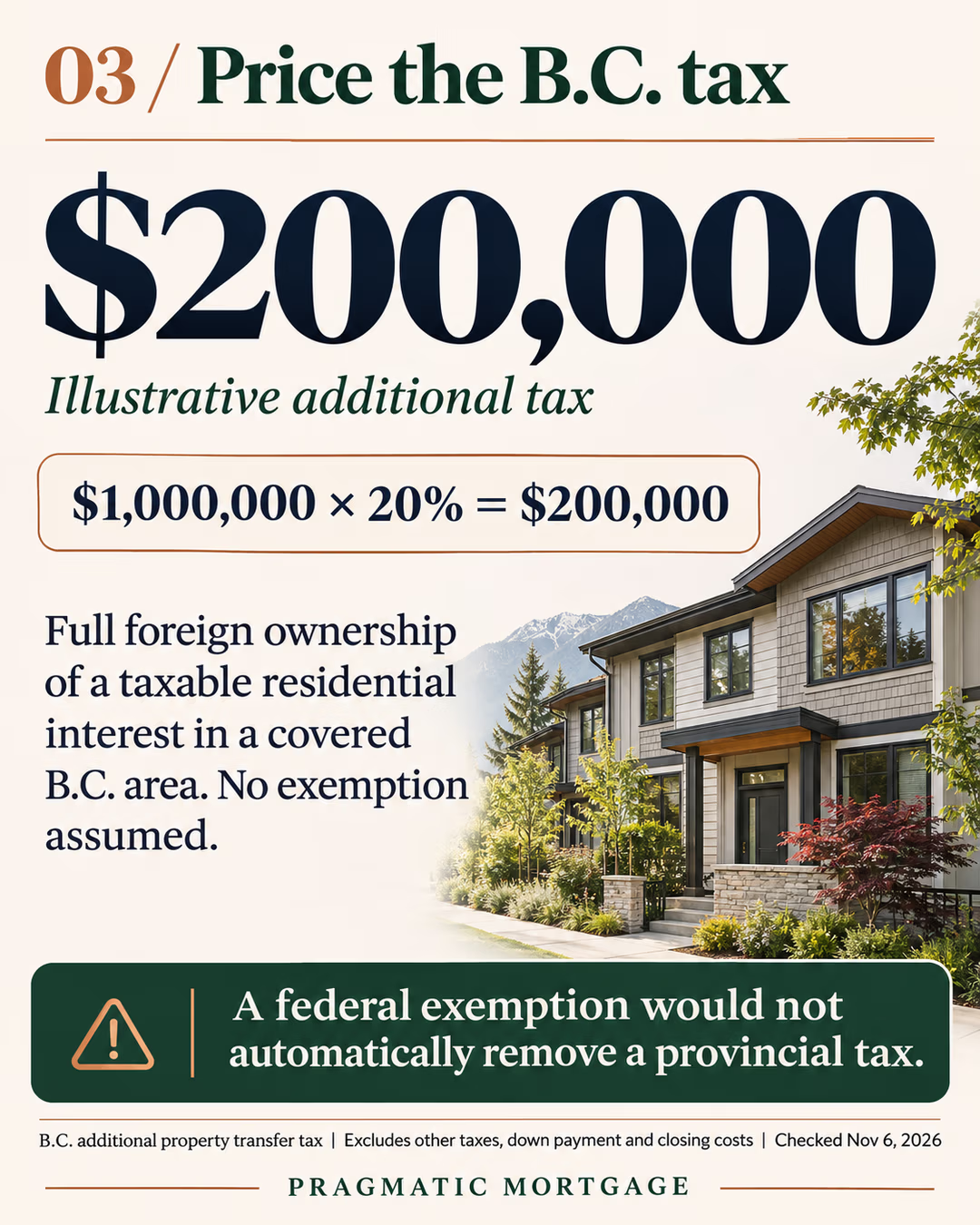
For example, 20% of a $1-million taxable residential interest is $200,000. That is an illustrative additional property transfer tax calculation, not a down payment or the total cost of closing. Exemptions and ownership share matter.
That gap between a headline and a closing statement is why this announcement deserves a careful read.
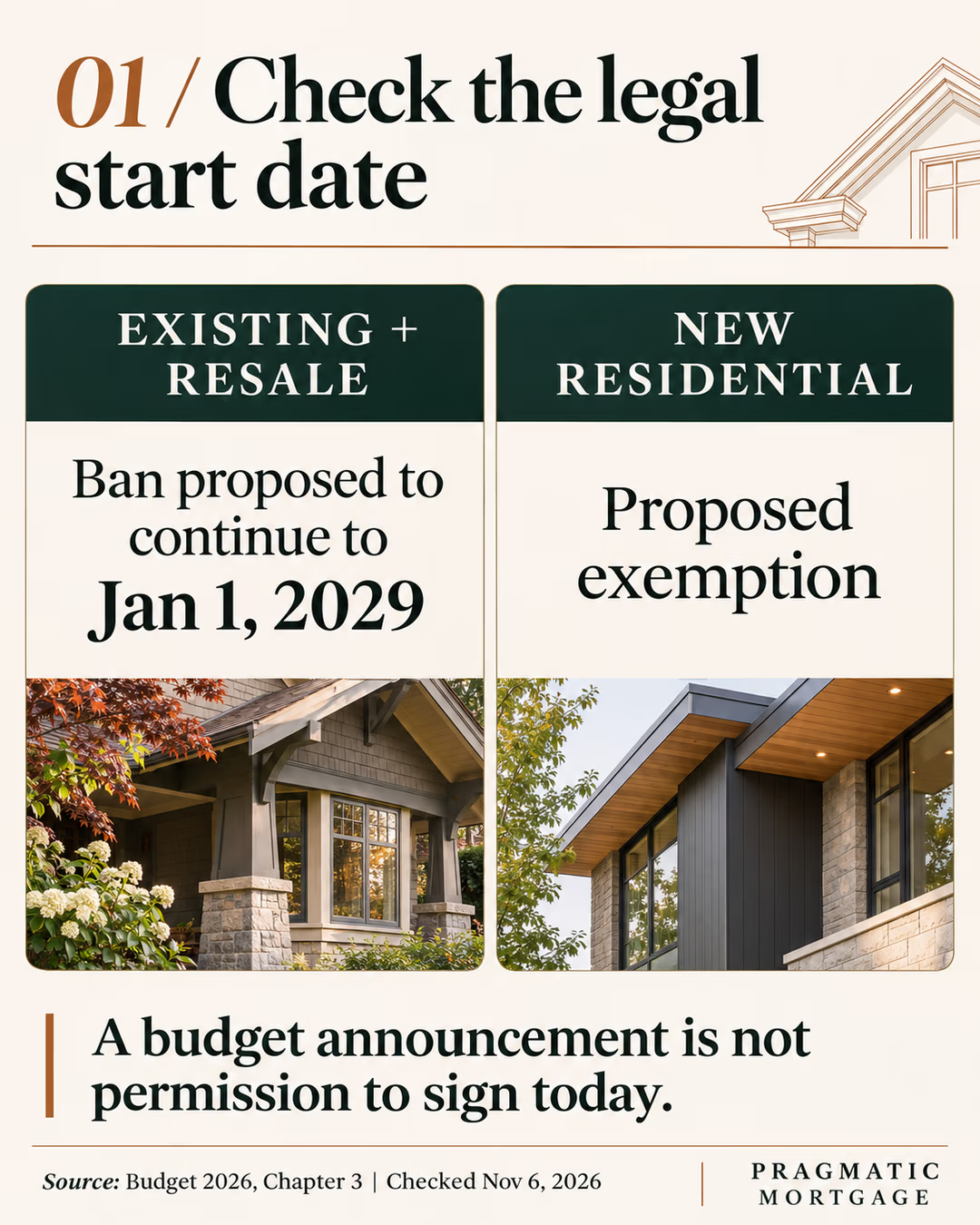
In Budget 2026, tabled November 5, Ottawa proposed keeping its foreign-buyer prohibition on existing and resale residential properties until January 1, 2029, while exempting new residential properties.
The government says legislation and a regulatory process will follow. Do not treat the announcement as an exemption already available for your purchase. Read the official budget proposal.
The one-minute version
- Existing and resale homes: Ottawa proposes a two-year extension, subject to the law’s scope and exceptions.
- New homes: a proposed opening, with implementation details still to follow.
- B.C. taxes: separate rules still need a separate check.
- Your mortgage: legal eligibility to buy does not establish financing approval.
Here are five checks that make the announcement useful for an actual purchase plan.
1. Check the legal start date before the listing description
The budget states the intended direction. It does not, in the passage announcing this change, establish the final definition of a qualifying new home, a commencement date, or transition rules for existing contracts.
Those are important gaps. A completed but never-occupied home, a presale contract and an assignment of that contract should not automatically be treated as identical. Neither should a renovated older property be assumed to qualify because its listing calls it “like new.”
Ask your lawyer or notary to confirm the operative rule for your buyer, property and contract date before you commit. The current regulations define a purchase to include acquiring a legal or equitable interest, with or without conditions. Waiting until title transfers may therefore be too late to identify an eligibility problem. Federal regulations, section 4.
The existing framework was extended to January 1, 2027 in 2024. That older extension is background, not proof that the new 2029 proposal has been implemented. Finance Canada’s 2024 announcement.
2. Understand how an extra buyer could help a project get built
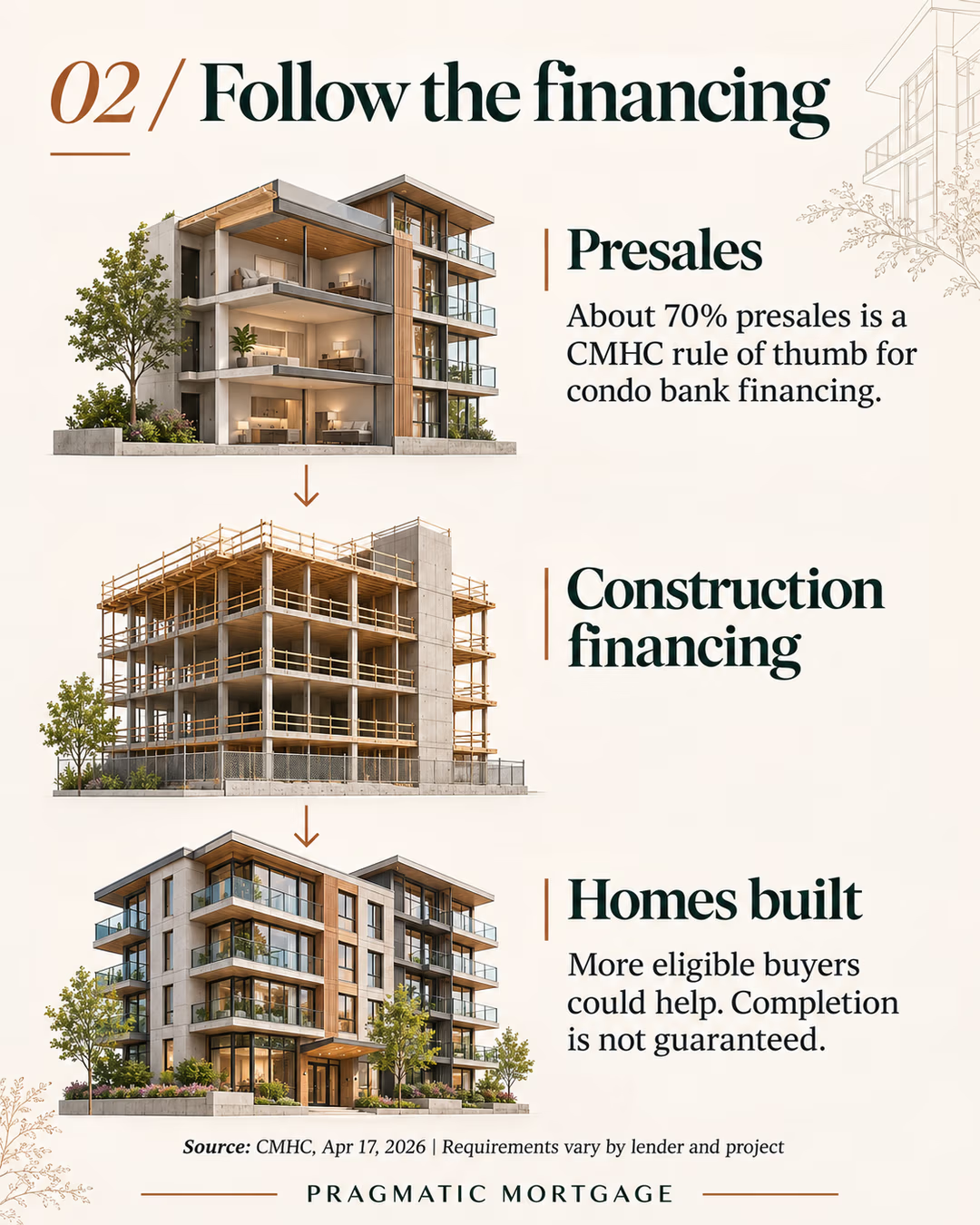
A presale is a contract to buy a home before it is finished. Those contracts can help a condominium developer demonstrate sufficient demand to obtain construction financing.
CMHC explains that a Canadian condo project generally needs about 70% presales before securing bank financing. It expressly calls this a rule of thumb: lenders and financing conditions differ.
It is not a statutory minimum and does not apply to every type of housing. CMHC’s April 17, 2026 construction analysis.
That gives the proposal a plausible supply mechanism: a wider pool of eligible purchasers could help some projects reach their financing threshold and move toward construction.
Our analysis
additional demand could also strengthen sellers’ bargaining power before new homes are delivered. Whether affordability improves depends on how much additional housing is actually completed, where it is built and at what cost.
An announcement alone does not establish a price forecast for Kelowna, Vancouver or Canada.
For a buyer, useful evidence is project-specific: financing status, permits, construction progress, remaining inventory and the contract’s completion provisions.
3. Keep B.C.’s 20% tax on its own line
British Columbia’s additional property transfer tax is separate from the federal purchase prohibition. The province says the additional rate is 20% of the fair market value of the foreign purchaser’s proportionate residential interest in specified areas.
Those areas include Metro Vancouver, the Capital Regional District, the Fraser Valley, the Central Okanagan and the Regional District of Nanaimo. The Central Okanagan list includes Kelowna, West Kelowna, Lake Country and Peachland. B.C. tax rules; covered areas.
Worked example
assume a foreign purchaser acquires the entire residential interest in a covered property with a $1-million fair market value, and no exemption applies:
$1,000,000 × 20% = $200,000 additional tax.
This excludes the down payment, general property transfer tax, any applicable GST, legal fees and other costs. A different ownership share or an applicable exemption changes the calculation.
The province lists exemptions including certain confirmed B.C. Provincial Nominees; eligibility requires a proper review.
Do not assume that a federal new-home exemption would cancel this provincial charge. Have your legal adviser prepare an itemized cash-to-close estimate for the actual transaction.
4. Identify the buyer’s status accurately
“Foreign buyer” is headline shorthand. The federal Act uses the term non-Canadian.
Canadian citizenship, permanent residency, temporary immigration status, tax residency and a corporation’s ownership are different questions. A Canadian citizen living abroad should not be assumed to be prohibited merely because they are non-resident for tax purposes. Federal Act.
There are already exceptions in the federal framework.
For example, the regulations provide a route for certain work-permit holders or people authorized to work in Canada who have at least 183 days of validity remaining on the purchase date and have not purchased more than one residential property.
Other conditions and exceptions have their own tests. Federal regulations, section 5.
Property scope matters too. CMHC explains that the current prohibition does not cover every property in every location, including properties outside census metropolitan areas and census agglomerations and certain larger residential buildings.
A condominium unit still needs its own assessment. CMHC’s guide and address lookup.
Bring the actual ownership structure and immigration documents to your adviser. A reassuring social post is not an eligibility opinion.
5. Test the mortgage at completion, not just at the sales centre
Even when a purchase is legally permitted, the lender must still assess it. FCAC explains that a pre-approval is not a guarantee of a mortgage; the property, your finances and the lender’s requirements still matter. FCAC’s pre-approval guide.
For a presale, the gap between signing and completion adds risk. BCFSA warns that financing can become more difficult if the finished home appraises below the agreed price.
Interest rates can also change. A buyer unable to complete may face a lost deposit and other contractual consequences. BCFSA’s consumer presale guide.
Our practical mortgage checklist is to ask for written answers to these questions:
There is no responsible universal promise that every foreign buyer can borrow with a particular down payment or receive the same mortgage rate. Get a lender-specific assessment.
What should Canadian buyers and homeowners do now?
Buying a new home
compare the project and financing terms on their merits. Ask what you would pay and how you would qualify if the policy details or market response differ from expectations.
Shopping for a resale
the proposal is not evidence that every resale price will rise or fall. Compare recent local transactions, competing listings and your own cash-flow limit.
Renewing a mortgage
this announcement does not itself change your mortgage contract or set the Bank of Canada’s rate. Keep the renewal decision focused on your actual offers, payment risk, penalties and plans for the property.
For a B.C. purchase, Pragmatic Mortgage Lending can help assess the financing side of your plan. Have your lawyer or notary confirm legal eligibility and tax treatment. Bring the property address, contract timeline, buyer status, down payment and income documents so the advice is specific. Talk through your purchase plan.
Quick answers
Is Canada’s foreign-buyer ban gone?
No. Budget 2026 proposes extending restrictions on existing and resale homes while exempting new residential properties. The implementation process and final rules still need to be checked.
Does the announcement mean a non-Canadian can sign for any new home now?
Do not assume that. Get advice on the current law, any applicable existing exception and the eventual commencement and transition rules before entering a contract.
Would the federal exemption remove B.C.’s additional property transfer tax?
Not automatically. It is a separate provincial tax with its own covered areas, definitions and exemptions.
Does buying a presale guarantee mortgage approval later?
No. The property valuation, your finances, lender requirements and rate-hold terms can affect financing at completion.
General information, not individualized legal, immigration, tax or mortgage advice. Brokerage services are for B.C. properties and subject to qualification and lender approval.
Policy status checked November 6, 2026; recheck before acting. Generated visuals are conceptual editorial illustrations, not photographs of actual developments. Designated editorial reviewer: Dinah Caporusso, Mortgage Broker.