


A 100% deduction does not mean a 100% refund. Here’s what Canada’s September 15 announcement could mean for business owners, property buyers and mortgage planning.
Canada wants businesses to build, modernize and invest. Its new proposal would let them write off many qualifying investments much sooner.
That could matter if you run a business, work in an investment-sensitive industry or are planning a mortgage. But the most useful part of this announcement is understanding what it does—and does not—change.
The 30-second version
- It is a proposal, not a homebuyer program. Finance Canada has released technical details and draft legislative proposals.
- The benefit is earlier tax deductions. An eligible cost could be deducted in the year the asset becomes available for use, rather than gradually.
- The building matters. Buildings in capital cost allowance classes 1 and 3 are excluded from this new measure. Separate temporary rules remain for eligible manufacturing and processing buildings.
- It does not set your mortgage rate or approve your mortgage. Business owners should connect their tax plan with their borrowing plan before committing cash.
What did the government announce?
On September 15, Prime Minister Mark Carney announced the proposed Productivity Mega Deduction at the Canada Investment Summit. It builds on the earlier Productivity Super-Deduction and would make immediate expensing permanent for a much broader range of business assets.
The Prime Minister’s Office says coverage would expand from roughly 15% to more than 65% of assets. Examples include technology, machinery and certain infrastructure.
These are broad headline descriptions—not a guarantee that a particular purchase qualifies. Prime Minister’s announcement.
Finance’s technical proposal generally covers qualifying property acquired on or after September 15, 2026. Acquired and available for use are different tests: placing an order does not necessarily establish the year you can deduct it. Asset classes, ownership history and other restrictions matter. Technical details and draft legislation.
A write-off is not free equipment
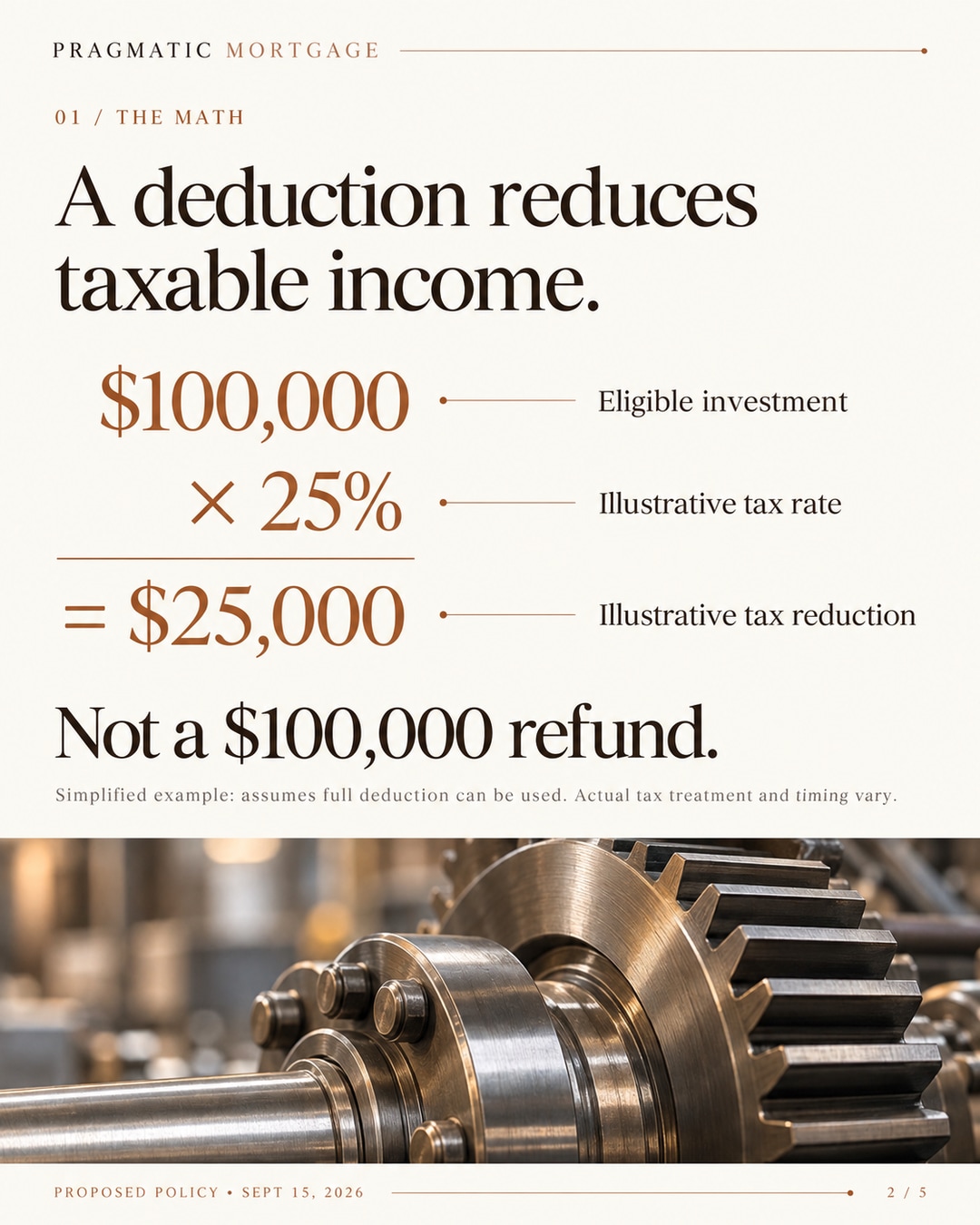
Think of a deduction as reducing the income on which tax is calculated. It is not the government returning the entire purchase price.
Here is deliberately simple arithmetic—not a personalized tax estimate
- Eligible investment fully deductible in the year: $100,000.
- Assumed applicable tax rate: 25%.
- Tax reduction if the full deduction can be used: $25,000.
$100,000 × 25% = $25,000. Not a $100,000 refund.
The business still needs to pay for or finance the asset. Its actual result depends on its tax position, applicable rates, eligibility and the timing of the deduction.
Also, that $25,000 is not necessarily an extra lifetime saving compared with existing depreciation rules. The important advantage is often getting deductions sooner. Do not count an assumed tax benefit as cash already available for your down payment.
The real-estate catch: equipment and buildings are not the same thing
Buying a machine for a business and buying the building that houses it are different tax questions.
The new proposal excludes buildings and additions in CCA classes 1 and 3.
It also excludes other specified asset classes and certain vehicles.
Used-property restrictions apply.
Eligible manufacturing and processing buildings retain a separate temporary immediate-expensing treatment; that does not make every commercial or rental building eligible for the new permanent measure. Finance Canada’s exclusions.
For a property investor, the useful question is not “Can I write off this property?” It is: “Which specific assets, if any, qualify—and under which rule?” Have an accountant confirm the treatment before building a purchase budget around it.
For someone buying a home to live in, this announcement is not a new rebate toward that purchase.

Why is Canada doing this?
The aim is to make investment more attractive: better equipment and technology can help businesses produce more with the resources they have. That is productivity in plain English.
The Bank of Canada explains that stronger productivity can let an economy grow more without generating inflation. That is a potential long-term benefit, not an immediate result from announcing an incentive. Bank of Canada: understanding productivity.
One headline number needs special care: Finance estimates that Canada’s marginal effective tax rate on new business investment would fall from 13.0% to 6.4%. This is a modelled investment-tax measure—not a new corporate income-tax rate, your personal tax rate or a mortgage rate. Finance Canada’s tax comparison.
There is a public cost, too. Finance estimates an incremental fiscal cost of $36 billion over five years, beginning in 2026–27.
The policy’s economic case depends on businesses actually investing and becoming more productive. Announced incentives are not the same as completed projects. Finance Canada’s fiscal estimate.
Does this mean cheaper mortgages or higher home prices?
Neither follows automatically.
The Bank of Canada makes monetary-policy decisions to keep inflation low and stable. A federal business tax proposal does not itself change that policy rate. Bank of Canada: monetary policy.
Our interpretation: if the incentive leads to real projects, it could eventually affect local employment, incomes and demand for space. More productive businesses could also ease some cost pressures.
But the size, location and timing of any effect are uncertain. An investment announcement is not evidence that homes in your neighbourhood will become more expensive—or less expensive.
Do not choose a fixed or variable mortgage solely on this headline. Start with the payment you can sustain, your tolerance for changes and the flexibility you need.
Self-employed? Put your accountant and broker in the same conversation
Your tax return and your mortgage application answer different questions. One calculates taxable income. The other helps a lender assess your ability to repay.
CMHC’s self-employed insurance guidance requires evidence of business history and financial stability. It also describes ways eligible deductions may be considered for sole proprietors and partnerships.
That is not a promise that any lender will add back this new deduction in full, or that all borrowers qualify. CMHC’s self-employed guidance.
Before a major investment alongside a home purchase, refinance or lender switch, ask:
Do this before spending—not after discovering that your mortgage file needs a different explanation or more documentation.
What to do with this news today
Buying a home
Keep your budget anchored to verified income, savings and actual financing options. Do not add an assumed business-tax benefit to your available closing cash.
Renewing soon
Compare your options on your existing timeline. Tell your broker about planned business borrowing or major investments, especially if you may switch lenders or refinance.
Running a business
Get a written eligibility and cash-flow assessment from your accountant. Then have the mortgage implications assessed separately.
Investing in property
Separate land, buildings and other assets in your questions. A broad policy headline is not a tax opinion on your deal.
The bottom line: a good tax plan and a good mortgage plan should work together. Neither should be built on a headline alone.

Talk through my mortgage plan · Explore renewal planning · Plan cash beyond the down payment
Quick answers
Is the Productivity Mega Deduction already final law?
Finance Canada presented it as a proposal on September 15, 2026 and released draft legislative proposals. This article describes the announcement, not an assurance of final enactment. Confirm the current rules before acting.
Does “100%” mean the government pays the whole cost?
No. A deduction reduces taxable income. The resulting tax benefit depends on the applicable tax rate and whether and when the deduction can be used.
Can I deduct my home purchase under this announcement?
This is a business-investment proposal, not a new personal home-purchase deduction or rebate. Do not treat it as down-payment assistance.
Should I delay my mortgage decision because of this?
The announcement alone is not a reason to miss a renewal deadline or change a purchase plan. Review your own income, cash, financing and risk tolerance with the appropriate professionals.
Sources
- Prime Minister’s announcement — September 15, 2026
- Finance Canada — proposal, technical eligibility and economic estimates
- Draft legislative proposals
- Bank of Canada — understanding productivity
- Bank of Canada — monetary policy
- CMHC — self-employed mortgage loan insurance
Prepared by Pragmatic Mortgage Lending. Editorial contact: Dinah Caporusso.
Sources checked September 15, 2026. Educational information, not personalized tax, legal or investment advice, a lending commitment or a forecast of mortgage rates.
Generated images illustrate fictional settings; they are not photographs of announced projects or property listings.