Canada has announced a financing change that could make a small rental building worth a second look. For a homeowner with a redevelopment idea, or a builder weighing a triplex or fourplex, the opportunity is practical: more room to finance the completed property, even if the owner lives somewhere else.
The planning question is just as practical: how much cash will the project need, and when? A headline about 90% financing answers only part of it.
Finance Canada published the new parameters on November 5, 2026. They apply to insurance applications that lenders submit to mortgage insurers on or after February 1, 2027.
Signing a purchase agreement now does not secure a loan under the new rules. Read the official backgrounder.
The quick answer
The announcement opens two distinct paths. One is for building new triplexes and fourplexes, or buying newly built ones.
The other allows private mortgage insurers to offer insurance on eligible properties with five to fifty units.
For a new three- or four-unit project, the published ceiling is 90% of projected completed value, with no owner-occupancy requirement or property-value cap.
Budget 2026 illustrates the change with a $3-million fourplex: a builder could retain all four homes as rentals after completion, or sell them.
A completed mortgage can amortize over up to 30 years. Budget 2026’s explanation and fourplex example.
These are financing parameters, not a promise that every project will receive a loan.
The $300,000 that needs an asterisk
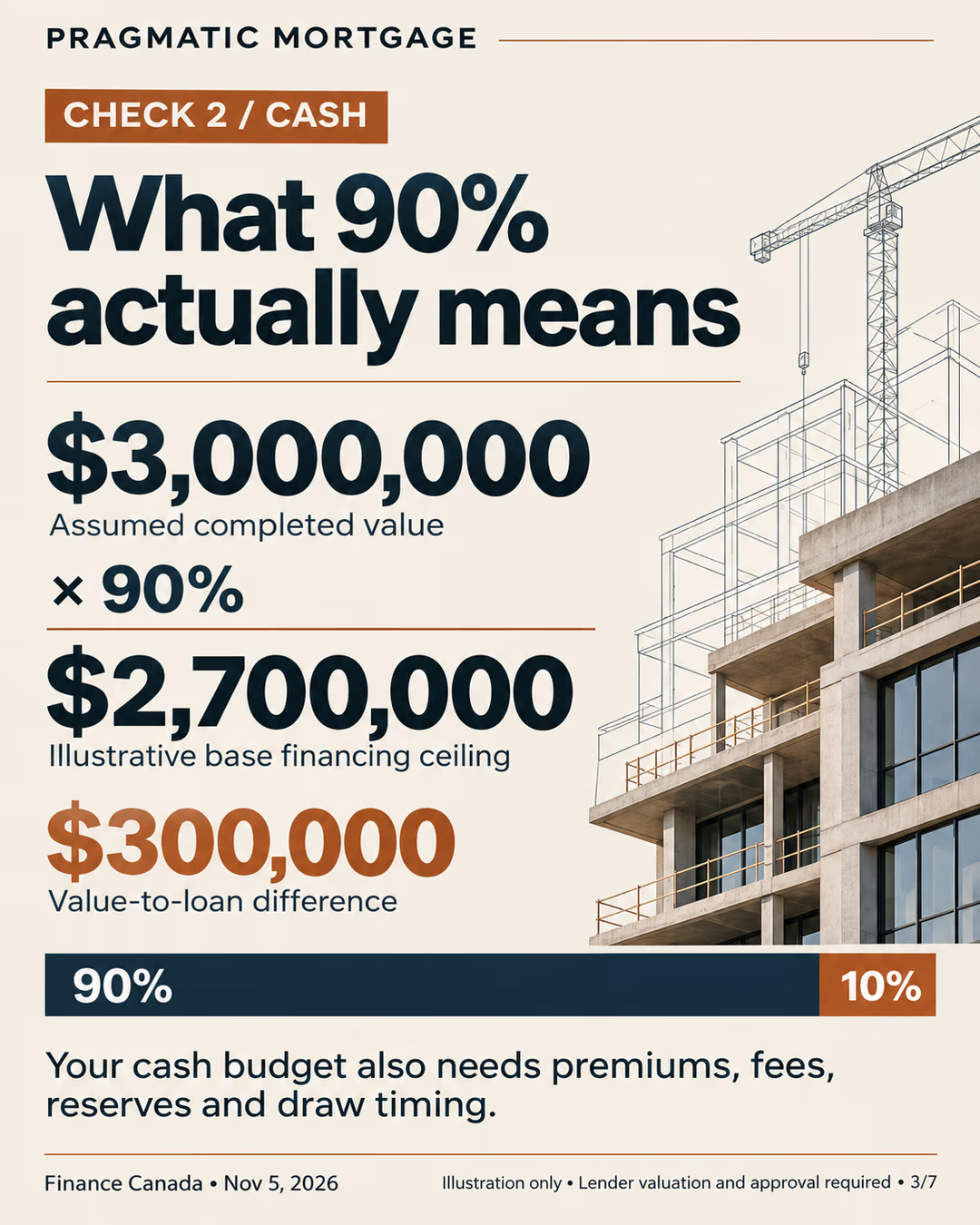
Here is our simplified calculation, using the same $3-million scale as the federal example:
| Assumption or calculation | Amount |
|---|---|
| Assumed lender-accepted completed value | $3,000,000 |
| 90% × $3,000,000 | $2,700,000 |
| Difference between that value and that base loan | $300,000 |
That $300,000 is a value-to-loan difference, before insurance premiums and other costs. It is not a complete project cash budget.
Land, construction costs and appraised value are different numbers.
Imagine total project costs are also $3 million, but the lender accepts a completed value of $2.8 million.
Applying 90% to the lower value produces $2.52 million.
The cost-to-loan gap becomes $480,000, before any additional expenses or reserves. This is our arithmetic illustration, not a lender quote or a forecast of property values.
A project also has a calendar. Deposits, design work, permits and invoices may fall due before a particular loan advance.
Ask for a month-by-month funding plan showing your own money, loan draws, interest, contingency and the financing needed after completion. Get the treatment of the insurance premium in writing rather than assuming it fits inside or outside a quoted loan amount.
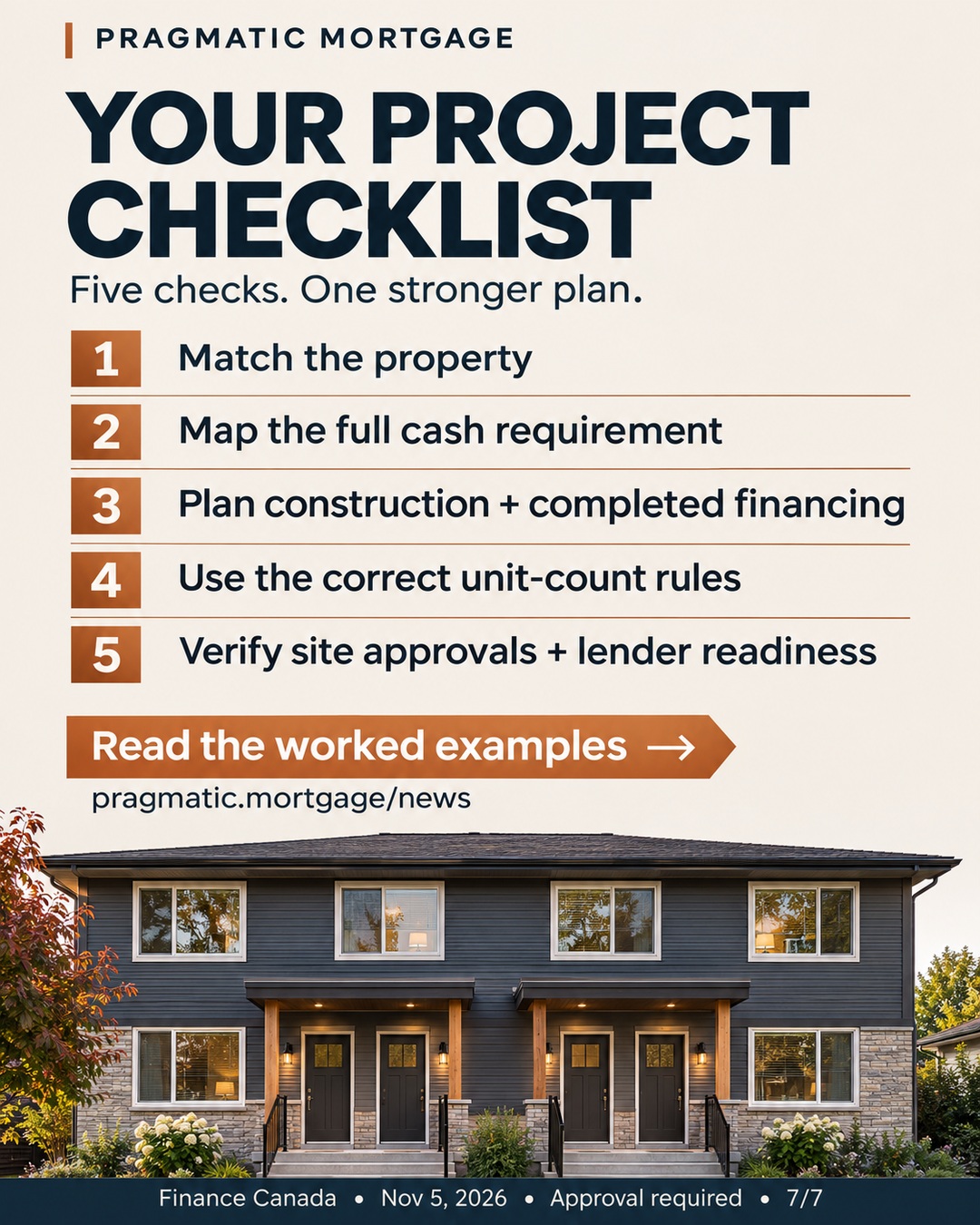
Five checks before you plan a build
1. Match the property to the right financing path
A newly built fourplex and an existing fourplex should not be treated as interchangeable under this announcement. The new three- and four-unit path is specifically about new construction and newly built purchases.
For the five-to-fifty-unit path, each dwelling must be self-contained, and the property must have a single title or ownership structure. Separately titled properties cannot be bundled just to reach the unit threshold.
The permitted transactions include construction, purchase, refinance and renewal. Finance Canada: property definitions and permitted uses.
Before paying for detailed drawings, ask a lender or broker how the proposed title structure, unit count and intended exit will be assessed. A plan to keep a rental building and a plan to sell individual homes can create different questions for your financing team and lawyer.
2. Separate the building loan from the completed mortgage
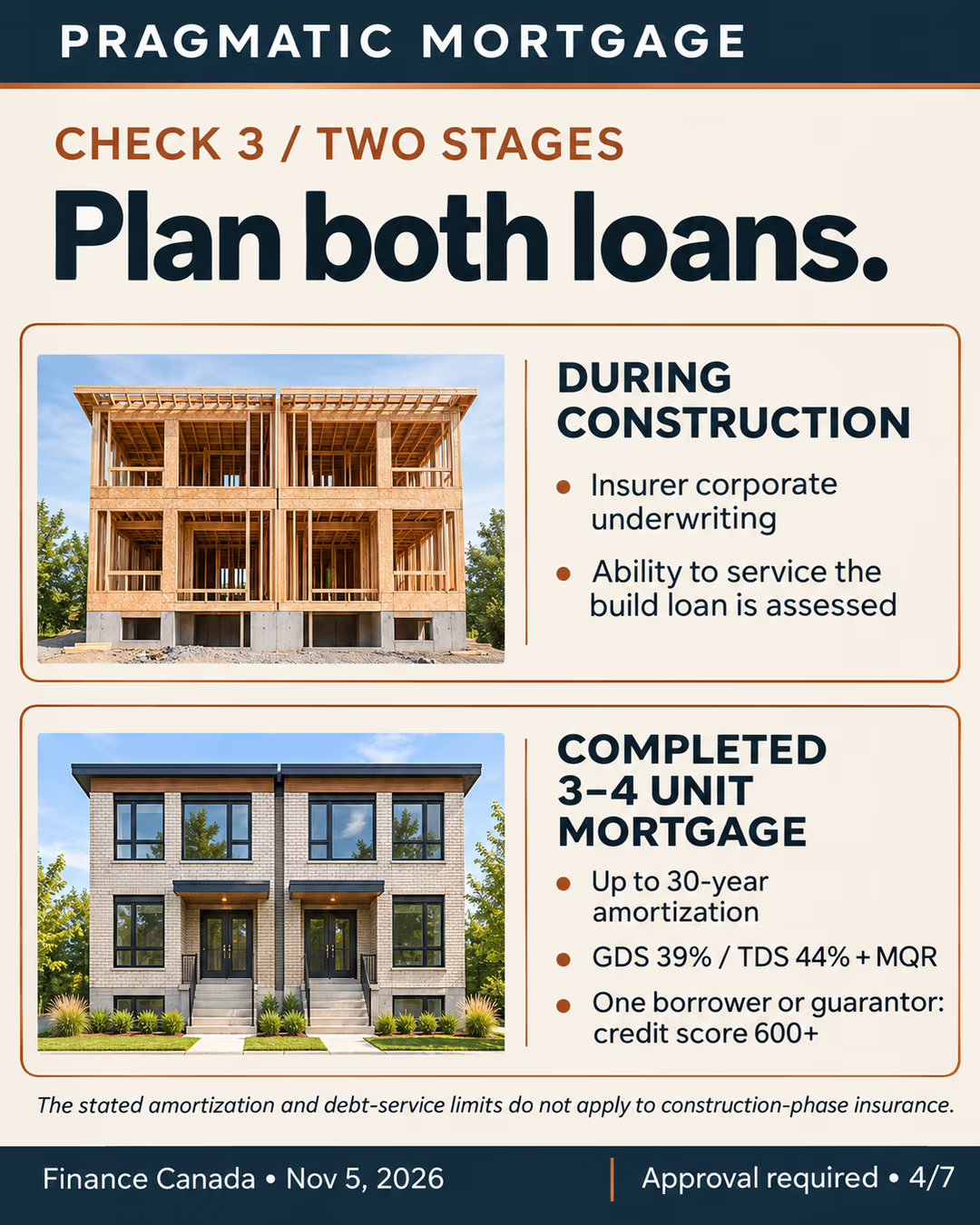
For three- and four-unit financing, the published qualification parameters include 39% GDS / 44% TDS, the minimum qualification rate, and a credit score of at least 600 for one borrower or guarantor at approval.
Construction has a separate treatment: the stated amortization and debt-service limits do not govern insurance of the construction phase. Insurers use their own corporate underwriting to assess construction-loan servicing.
The same distinction applies to the amortization and coverage tests in the larger-property path. Finance Canada: underwriting parameters and construction exceptions.
In plain language, a construction lender still needs to be satisfied that the project and borrower can carry the loan. Ask two separate questions: “How will the build be funded?” and “What must be true to obtain the completed mortgage?”
Mortgage default insurance protects the lender against losses from borrower default. It does not insure the borrower against an unsuccessful development. OSFI explains mortgage insurance and prudent underwriting.
3. Check the larger-building numbers separately
For the five-to-fifty-unit path, the published maxima are 90% loan-to-value and 50-year amortization for new construction, versus 85% and 40 years for other transactions. These longer amortizations belong to this path, not the triplex/fourplex path.
The minimum net-operating-income-to-debt-service ratio is 1.15 for a five-year term or 1.10 for a ten-year term.
The borrower’s required net worth, assessed using Canadian-held assets, is 25% of the requested loan, with a $100,000 minimum.
The construction-stage exception described above still matters. Finance Canada: five-to-fifty-unit eligibility.
To make those tests tangible, our illustration of $115,000 in annual net operating income divided by $100,000 in annual debt service equals 1.15.
That is income after operating expenses, not simply the total rent collected.
A separate illustration: 25% of a requested $2.7-million loan is $675,000.
A net-worth test and the cash needed to close are different tests; satisfying one does not establish that you satisfy the other.
4. Verify the site before relying on the financing
Insurance eligibility does not grant building permission. A financeable concept still needs a workable site and the required approvals.
In Kelowna, the city’s small-multi-family application guidance calls for materials such as current title information, plans and applicable engineering, energy-efficiency and warranty documentation.
It also identifies a separate application for each building.
Use the city’s actual checklist for your design rather than assuming a federal announcement settles local requirements. Kelowna’s permit guide and application links.
Have your planning and design professionals check what the specific property permits, what servicing is available and what approvals remain. Ask for written scope and cost estimates before turning a financing ceiling into a purchase budget.
5. Use the runway to February to make the file stronger
You can prepare a credible proposal before products begin. Bring a lender or broker the address and title information, intended number of units, preliminary plans, a realistic cost breakdown, your available capital, and your intended hold-or-sale strategy. Add rent evidence and operating expenses where rental income is central to the plan.
Ask which participating lender and insurer are expected to offer a suitable product, what remains to be confirmed, and who will verify readiness when the application window opens. Avoid treating an announcement as a rate hold, commitment or guaranteed closing date.
Why this could matter for housing
The economic logic is straightforward: a project that previously could not obtain suitable financing may become viable if the financing can reflect more of its completed value. For a small builder, being able to live elsewhere can also make a rental project more practical.
This is our interpretation of the financing change, consistent with the government’s stated goal of supporting more missing-middle homes.
The outcome will still depend on real costs, achievable rents or sale proceeds, permits, appraisals, lender participation and the ability to service the debt. The announcement alone cannot tell us how many additional homes will be built or what local prices will do.
For a B.C. project, talk with Pragmatic Mortgage Lending about the financing questions to resolve first. Bring the concept early enough that the funding plan can shape the project before expensive commitments are made.
Questions readers are asking
Can I use these rules for a loan today?
The announced start is February 1, 2027, based on when a lender submits the mortgage insurance application to the insurer. Product availability and your approval still need confirmation.
Does 90% financing mean I need only 10% in cash?
Your complete cash requirement depends on project costs, lender valuation, advances, premiums, fees and reserves. The percentage alone cannot establish the cash you will need.
Can an existing triplex use the new three- and four-unit path?
That announced path covers new construction and newly built purchases. Ask about the financing available for an existing property rather than assuming this new path applies.
Can a fourplex have a 50-year amortization under this announcement?
The longer amortization belongs to the separate five-to-fifty-unit path. The published maximum for a completed three- or four-unit mortgage is 30 years.
Source check
November 6, 2026.
Based on Finance Canada’s November 5 parameters, Budget 2026 and the official guidance linked above.
Examples are illustrative, before premiums and other costs, and are not offers of credit.
Lender and insurer approval are required.
Pragmatic Mortgage Lending serves borrowers in British Columbia.
Images are AI-generated editorial illustrations; buildings shown are conceptual, not actual listed or financed properties.