
October 28, 2026 decisions • Prepared October 29 UTC • Pragmatic Mortgage Lending editorial
If your mortgage renews this winter, the most useful question is not which central bank sounded tougher. It is which rate reaches your payment—and what happens if the next forecast is wrong.
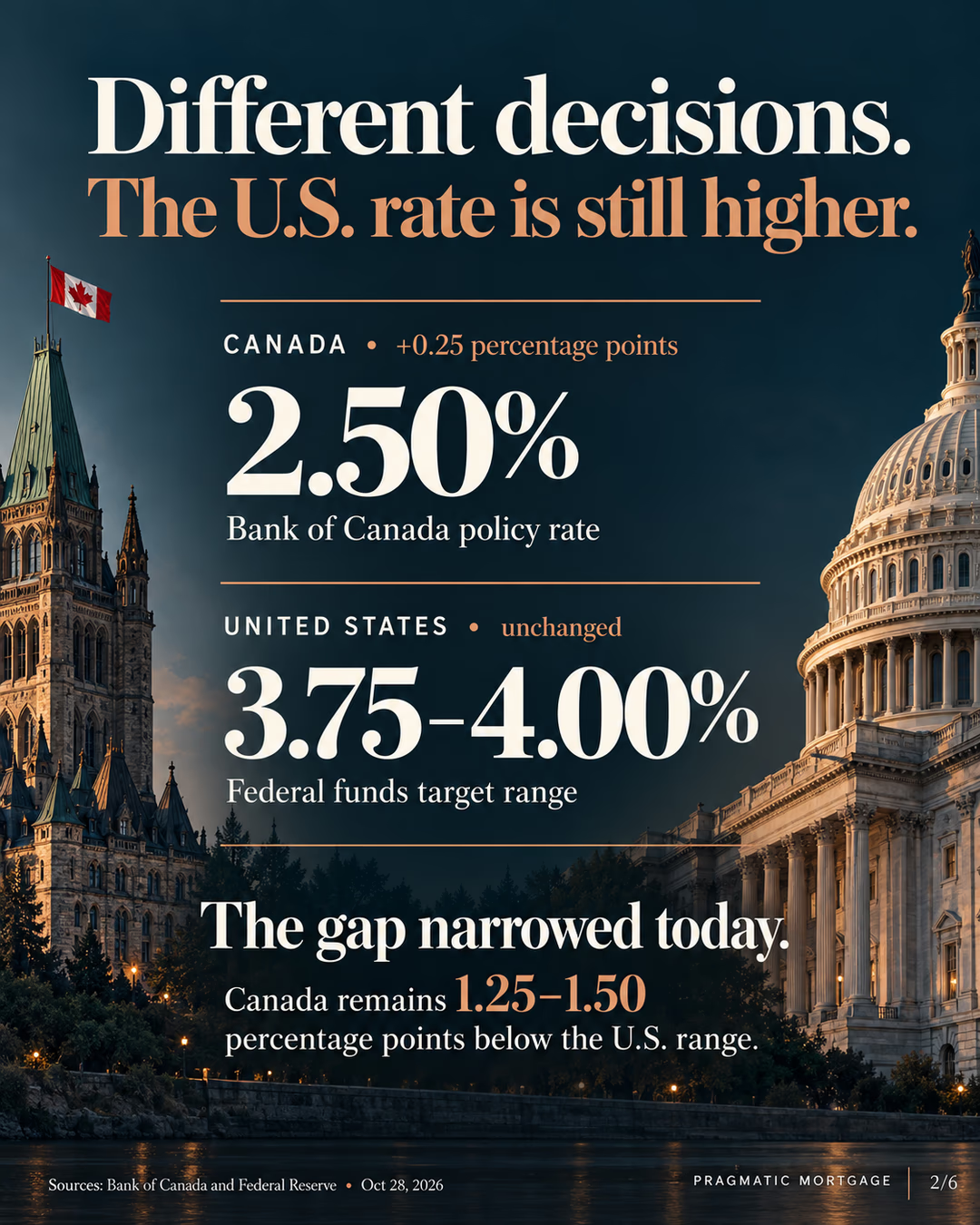
On October 28, the Bank of Canada raised its policy rate by 0.25 percentage points to 2.50%.
The U.S.
Federal Reserve left its target range at 3.75%–4.00%.
Those decisions look like a split.
Yet Canada’s rate moved closer to America’s: it is still 1.25–1.50 percentage points lower. Bank of Canada decision; Federal Reserve decision.
That is the first thing worth taking away: a hike versus a hold tells you the direction of one move, not how high borrowing costs already are. Neither policy rate is a mortgage offer.
The 60-second answer
- Canada acted against a future risk: expensive energy spreading into other prices, even though underlying inflation has been relatively subdued.
- The Fed chose to gather more information: a hold did not mean inflation was beaten, or that cuts were next.
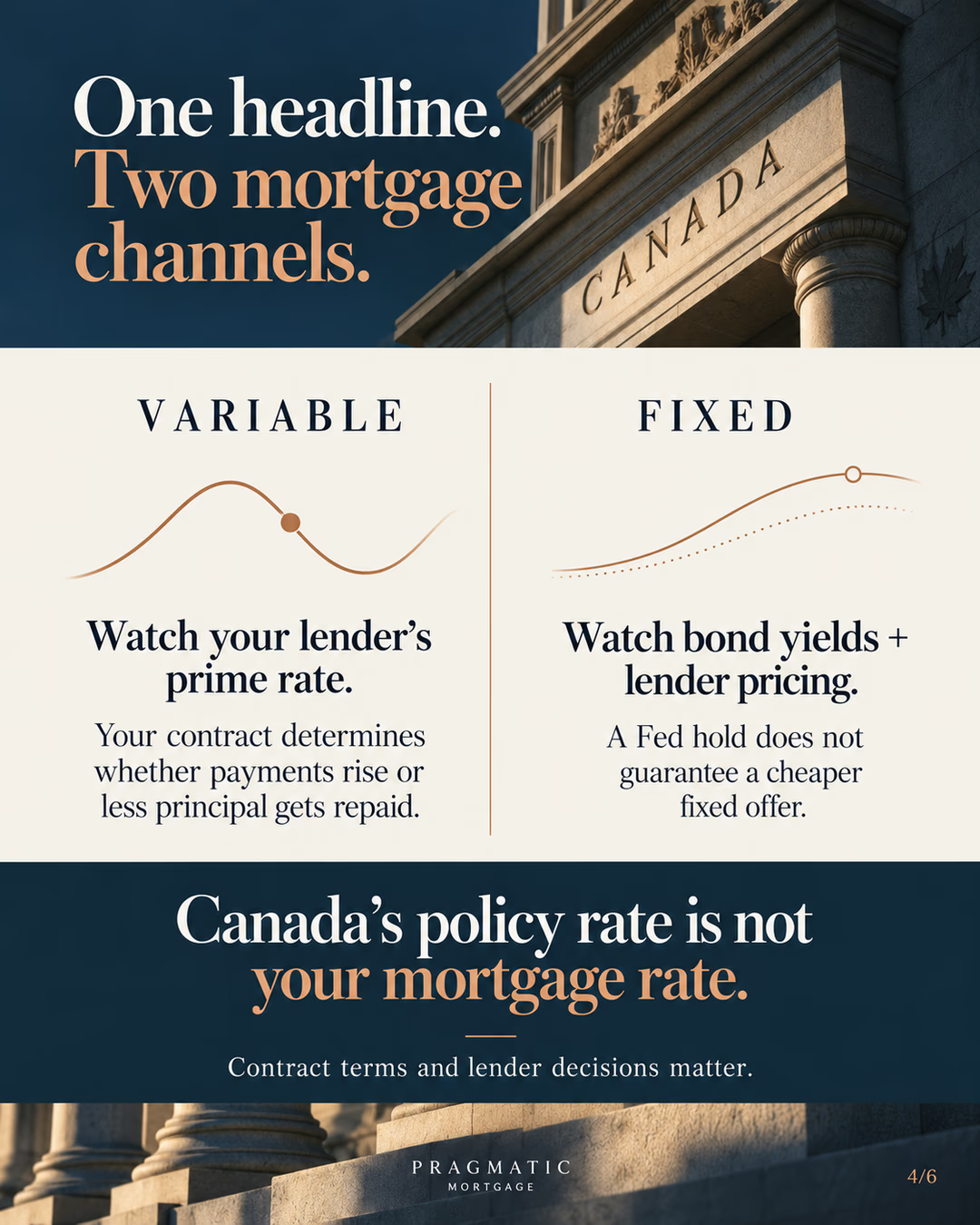
- Your variable mortgage and your next fixed offer travel through different channels. One follows lender prime and your contract; the other reflects bond-market funding costs and lender pricing.
- The Big Five do not offer one dependable timetable. Date-stamped forecasts are useful planning inputs, not a reason to leave a tight budget exposed.
Why raise rates when Canada does not feel like a booming economy?
Because the Bank is trying to manage tomorrow’s inflation, not simply reward or punish today’s economy.
September’s Canadian CPI rose 3.1% from a year earlier.
Gasoline was up 27.8%, but CPI excluding gasoline rose 2.2%.
That is an important distinction: much of the headline pressure came from fuel, rather than every part of the household budget accelerating together.
Excluding gasoline is not the same measurement as the Bank’s core inflation indexes. Statistics Canada, released October 19.
The concern is persistence. A short-lived fuel spike can be absorbed.
Months of expensive diesel, shipping and other inputs make it harder for businesses to hold their prices. The Bank’s October report says core inflation remains near 2%, but firms anticipate passing through more of their increased costs. October Monetary Policy Report overview.
Higher rates cannot reopen a shipping route or manufacture oil. They can restrain spending and borrowing, making it harder for temporary cost increases to become continuing, widespread inflation.
That is the risk-management logic—not proof that the broader economy is suddenly overheating.
There is a trade-off. The Bank projects Canadian growth of 1.0% in 2026 and 2.0% in 2027, while inflation stays around 3% through much of next year.
It is balancing recovery against the danger of inflation lasting longer. These are its projections, not observed results. Bank of Canada’s October outlook.

Why did the United States hold instead?
Not because America has no inflation problem. Its September headline CPI was 3.7% year over year, and CPI excluding food and energy was 2.6%. These are U.S. CPI measures; the Fed’s 2% inflation objective is assessed using PCE inflation, a different index. Do not read a cross-border CPI comparison as a complete policy scorecard. U.S. Bureau of Labor Statistics; Fed’s inflation target explained.
The Fed described strong activity and resilient spending, while saying more information would help it determine the appropriate policy stance. Ten members voted to hold; two preferred a quarter-point increase. That is a pause with disagreement, not an all-clear. FOMC statement, October 28.
Our interpretation: the two central banks made different timing decisions from different starting points.
The Fed already has a higher nominal rate; Canada is reacting to its own inflation outlook and economic conditions.
A higher nominal rate alone does not prove policy is more restrictive—expected inflation, financial conditions and each economy’s neutral rate also matter. Neither country has to copy its neighbour’s meeting-by-meeting moves.
What do the Big Five see over the next three to six months?
Here is the useful comparison for late January through late April 2027. March-end forecasts fall inside that window. June-end numbers do not, so we have not quietly presented them as six-month forecasts.
The publication dates below matter. Canadian post-decision commentary is available, but not every bank has released a matching post-decision U.S. forecast. Older U.S. baselines are labelled; they are not represented as fresh October 28 calls.
RBC: another Canadian hike in December or January
Canada
Another quarter-point increase in December or January would mean 2.75%. Its broader base case allows three further hikes after October’s, but does not put all three inside our six-month window.
United States
Its October 13 narrative expects quarter-point increases in December and March, reaching 4.25%–4.50%.
Dates
Canadian view: October 28, post-decision. U.S. baseline: October 13, pre-decision.
TD: another Canadian hike looks likely, but no meeting date
Canada
One more hike would take the rate to 2.75%, followed by greater caution. Its economist does not name a meeting.
United States
The September table has a 4.25% upper bound at March-end, equivalent to 4.00%–4.25%.
Dates
Canadian view: October 28, post-decision. U.S. table: September, pre-decision. The older table’s Canadian hold path has already been superseded.
BMO: more tightening, with uncertain timing
Canada
Its October 23 outlook shows a 2.75% average overnight rate in Q1. Its October 28 analysis expects further tightening, but December is not assured.
United States
Its October 23 outlook shows a 4.21% quarterly-average fed funds rate in Q1.
Important difference
These are quarterly averages—not March-end targets, and not directly comparable with the endpoint forecasts from other banks.
Sources
Canada table, October 23, U.S. table, October 23, Canadian decision analysis, October 28.
CIBC: December hold, January hike, then stop
Canada
Expects 2.75% in January, followed by no further increases in 2027.
United States
Its March-end midpoint forecast is 4.125%, equivalent to a 4.00%–4.25% target range. We converted the midpoint to a 0.25-point range for readability.
Dates
Both the Canadian commentary and the updated Economics/FICC forecast table are October 28, post-decision.
Scotiabank: December hike and a higher eventual peak
Canada
Expects a December hike. Its October 13 table puts the policy rate at 3.00% at March-end. Its October 28 commentary retains 3.25% in the first half of 2027, without specifying that it will be reached by April.
United States
Its table has a 4.50% upper bound at March-end, equivalent to 4.25%–4.50%. The post-decision Fed analysis still expects a December hike.
Dates
Canadian commentary and Fed commentary: October 28. Quantified quarterly table, page 7: October 13.
The takeaway is disagreement about timing and how far—not a guarantee of rapid cuts. Do not average unlike measures into a fake “Big Five consensus.” These are policy-rate forecasts, not advertised mortgage rates or personalized advice.
Could the paths converge—or diverge again?
Converging does not necessarily mean meeting at the same number. On October 28, the gap narrowed even though one bank hiked and the other held.
Consider two scenarios, not predictions:
- If Canada adds another 0.25 points while the Fed holds, Canada reaches 2.75% and the gap narrows further.
- If both add 0.25 points, Canada reaches 2.75% and the Fed reaches 4.00%–4.25%. The gap is unchanged from today, even though both rates are higher.
The verified bank forecasts do not establish a shared date when the two policy rates become equal. Energy prices, cost pass-through, jobs and trade developments could change the paths.
A currency move also depends on what markets had already expected; a Canadian hike is not a guaranteed rise in the dollar.
Your mortgage has two moving parts
Variable: lender prime, then your contract. If prime and your mortgage rate rise, an adjustable payment may rise. With a fixed-payment variable mortgage, the payment may initially stay the same while less principal gets repaid.
Ask about your remaining amortization, trigger provisions and conversion terms. FCAC’s mortgage-interest guide.
Fixed: bond yields, funding costs and lender pricing. An existing fixed rate stays fixed for its term.
A new fixed offer can change before a central-bank meeting because markets price the expected future path.
U.S. yields can influence Canadian funding conditions.
A Fed hold, by itself, does not promise a cheaper renewal. TD’s October 20 bond-market analysis.
Put the quarter-point into your own budget
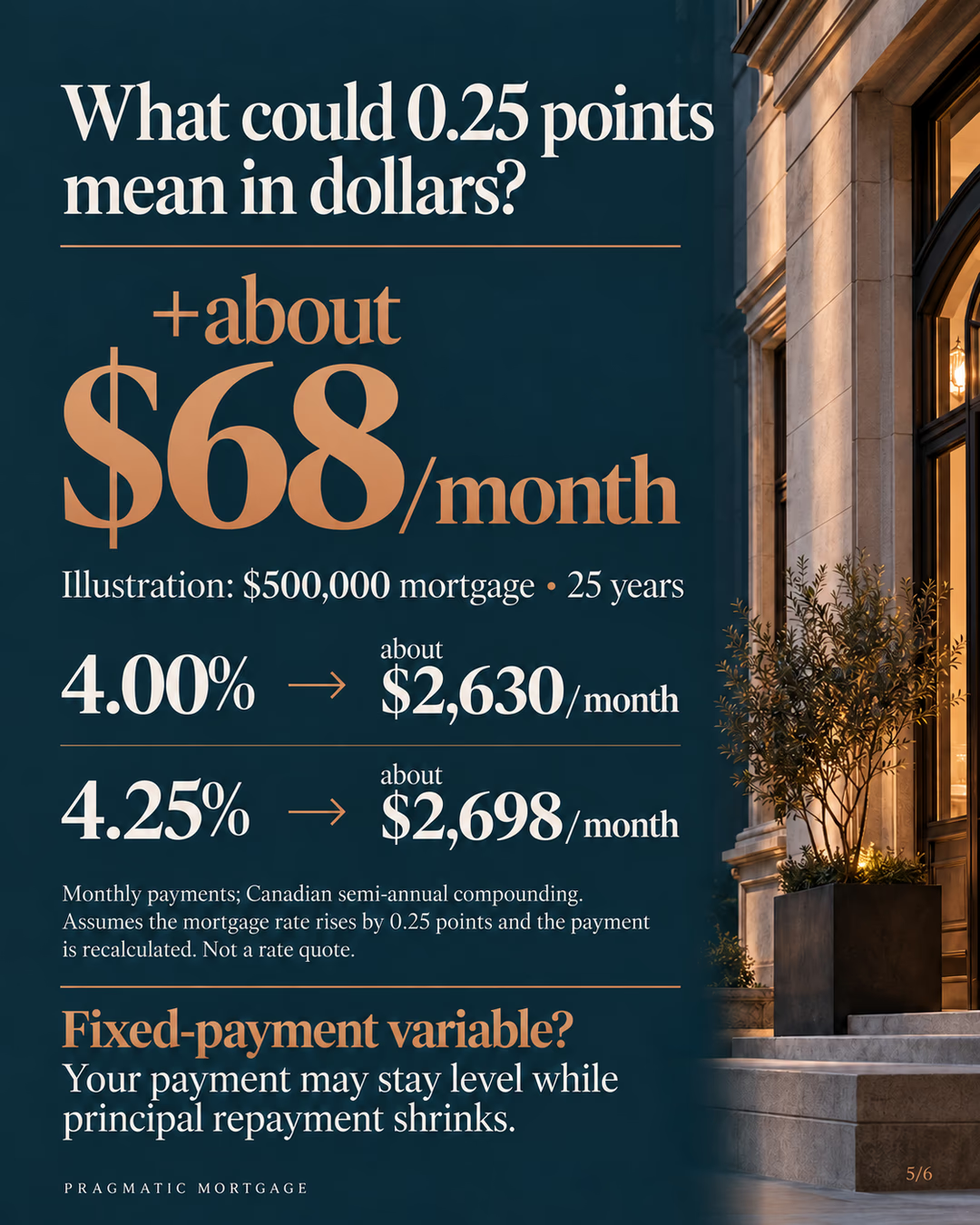
For a $500,000 balance with 25 years remaining, monthly payments would be approximately:
- 4.00%: $2,630.10 a month.
- 4.25%: $2,698.30 a month—$68.20 more than at 4.00%.
- 4.50%: $2,767.36 a month—$137.26 more than at 4.00%.
These are our calculations using Canadian nominal rates compounded semi-annually, monthly payments and 300 payments remaining. They assume the mortgage rate changes and the payment is recalculated.
They exclude fees, insurance premiums and property taxes. They are not current offers, lender quotes or predictions. A fixed-payment variable contract can behave differently.
A better plan for a renewal or purchase
Renewing this winter? Get competing offers before your deadline. Ask for your payment at the actual offered rate, plus 0.25 and 0.50 points. Also compare remaining amortization, conversion conditions and the cost of breaking the mortgage if you move.
Buying this spring? Ask whether a rate hold is available, when it expires, whether a lower rate can be captured and which approval conditions remain. A pre-approval is not a guaranteed closing. Keep your down payment, closing costs and emergency cash separate.
Already in a variable? Request a written breakdown of the new rate, payment, principal repayment and remaining amortization. If the higher-payment scenario is uncomfortable, compare fixed and variable options now; conversion is not automatically free or the best available deal.
The Bank of Canada’s next scheduled decision is December 9. That is a useful checkpoint, not a reason to miss your own financing deadline. Official decision release.
For a BC property, ask Pragmatic Mortgage Lending for a two-plan comparison
what works if rates pause, and what still works if they rise. Bring your balance, renewal or closing date, remaining amortization and realistic monthly comfort limit.
The goal is a mortgage you can live with, not a prediction you have to get exactly right. Start your comparison.
Quick answers
Does the Canadian hike mean every mortgage payment goes up now?
No. Existing fixed rates do not change during their term. Variable-rate effects depend on lender prime, payment structure and the contract. A fixed-payment variable mortgage can repay less principal without an immediate payment increase.
Does the Fed hold mean U.S. rates are about to fall?
No. The October 28 decision left rates unchanged; two voters preferred an increase. Future moves depend on incoming information.
Are more Canadian hikes certain?
No. Several banks expect further increases, but the timing and extent differ. Their projections can change. Plan around payment scenarios rather than a single forecast.
Should I automatically switch to fixed?
No. Compare the available rates, payment risk, conversion terms, prepayment penalties and your likely time in the property. A suitable decision depends on your circumstances, not the headline alone.
General education, not individualized financial, tax or investment advice. Mortgage services are for BC properties and subject to qualification and lender approval.
Forecasts are dated views, not promises. Generated images are conceptual editorial illustrations, not photographs documenting the announcements or actual properties.