


The next Bank of Canada move could be up. Here’s your mortgage playbook.
For more than a year, the loudest mortgage question in Canada has been: When is the next rate cut?
New Bank of Canada data suggests borrowers may need to ask a different question: What if the next move is up?
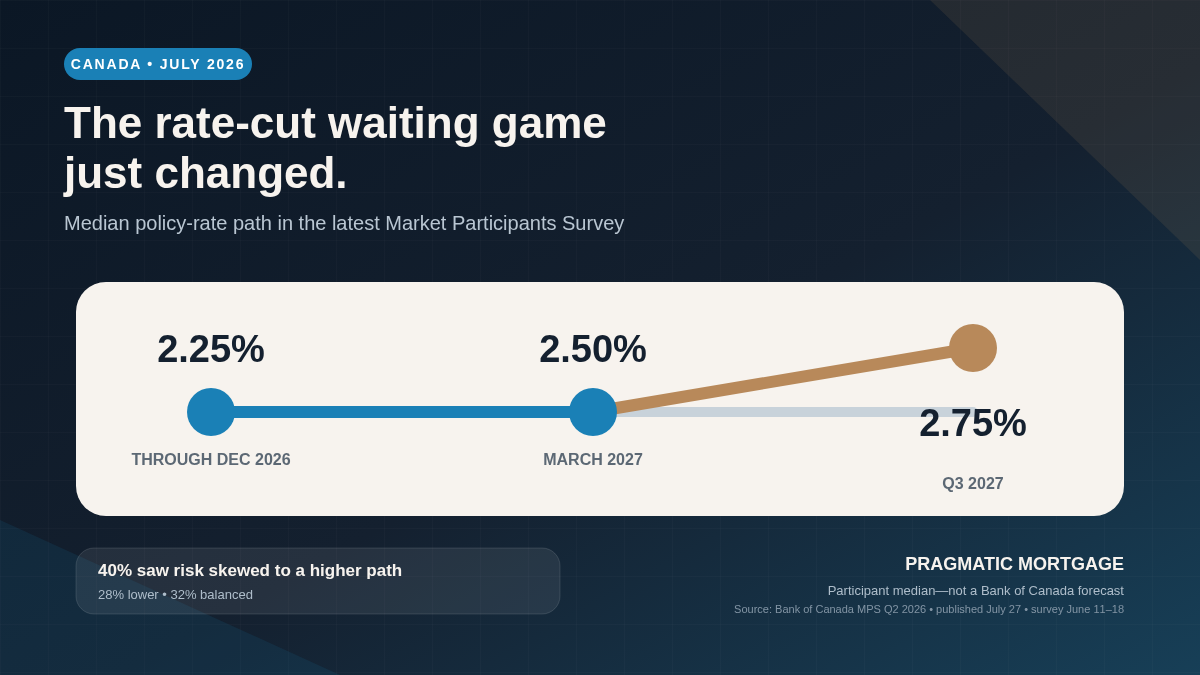
On July 27, 2026, the Bank published its latest Market Participants Survey. The median view among roughly 26 financial-market participants was that the policy rate stays at 2.25% through the end of 2026, then rises to 2.50% by March 2027 and 2.75% by the third quarter of 2027.
That is not a rate announcement. It is not the Bank of Canada promising a hike.
The survey was conducted June 11–18 and reports what market participants expected at that time. But it is a meaningful change in the mortgage conversation—and a warning against building your entire plan around a cut that may not arrive.
The signal, in four numbers
The survey’s median path was
- 2.25% through December 2026
- 2.50% by March 2027
- 2.75% by Q3 2027
- 40% of respondents saw the risk skewed to a higher path, compared with 28% who saw the risk skewed lower and 32% who viewed the risks as balanced
The same group’s median forecast put the five-year Government of Canada bond yield at 3.15% at the end of 2026 and 3.10% at the end of 2027. That matters because fixed mortgage pricing is influenced more by bond yields and lender funding costs than by the overnight rate alone.
The takeaway is not “rates are definitely going up.” It is this: a hold is now the central case, a hike is credible, and a cut is only one branch of the tree.
Why the rate-cut waiting game just got riskier
The Bank of Canada held its overnight rate at 2.25% on July 15. It has now been at 2.25% since October 2025.
In its July 2026 Monetary Policy Report, the Bank said inflation is elevated in the near term and identified Canada–U.S. trade relations and the war in the Middle East as the two biggest risks to the inflation outlook.
That combination makes the path awkward
- Canada’s economy has been weak, which normally argues for lower rates.
- Headline inflation has moved above 3%, while inflation excluding gasoline is near 2%.
- Energy and supply-chain shocks can keep inflation elevated even when domestic demand is soft.
In plain language, the Bank may not have the freedom to cut just because growth is slow. If inflation stays sticky, a long hold—or eventually a hike—remains possible.
Variable and fixed mortgages are hearing different music
This is where many mortgage headlines fail borrowers.
Variable-rate mortgages are tied more directly to lender prime rates, which generally move with Bank of Canada policy decisions. If the overnight rate stays at 2.25%, variable borrowing costs may remain broadly stable. If the Bank raises, variable rates would normally rise too.
Fixed mortgage rates are driven more by Government of Canada bond yields, lender funding costs, competition, and product-specific risk. A Bank of Canada hold does not freeze fixed rates.
Bond markets can move before the Bank acts—and sometimes move in the opposite direction from the overnight rate.
That is why “I’ll wait for the next Bank of Canada cut” is not a complete fixed-rate strategy. The fixed rate available when you are ready to close may be higher or lower even if the policy rate has not changed.
The renewal clock is still running
The stakes are real for households renewing out of pandemic-era mortgages.
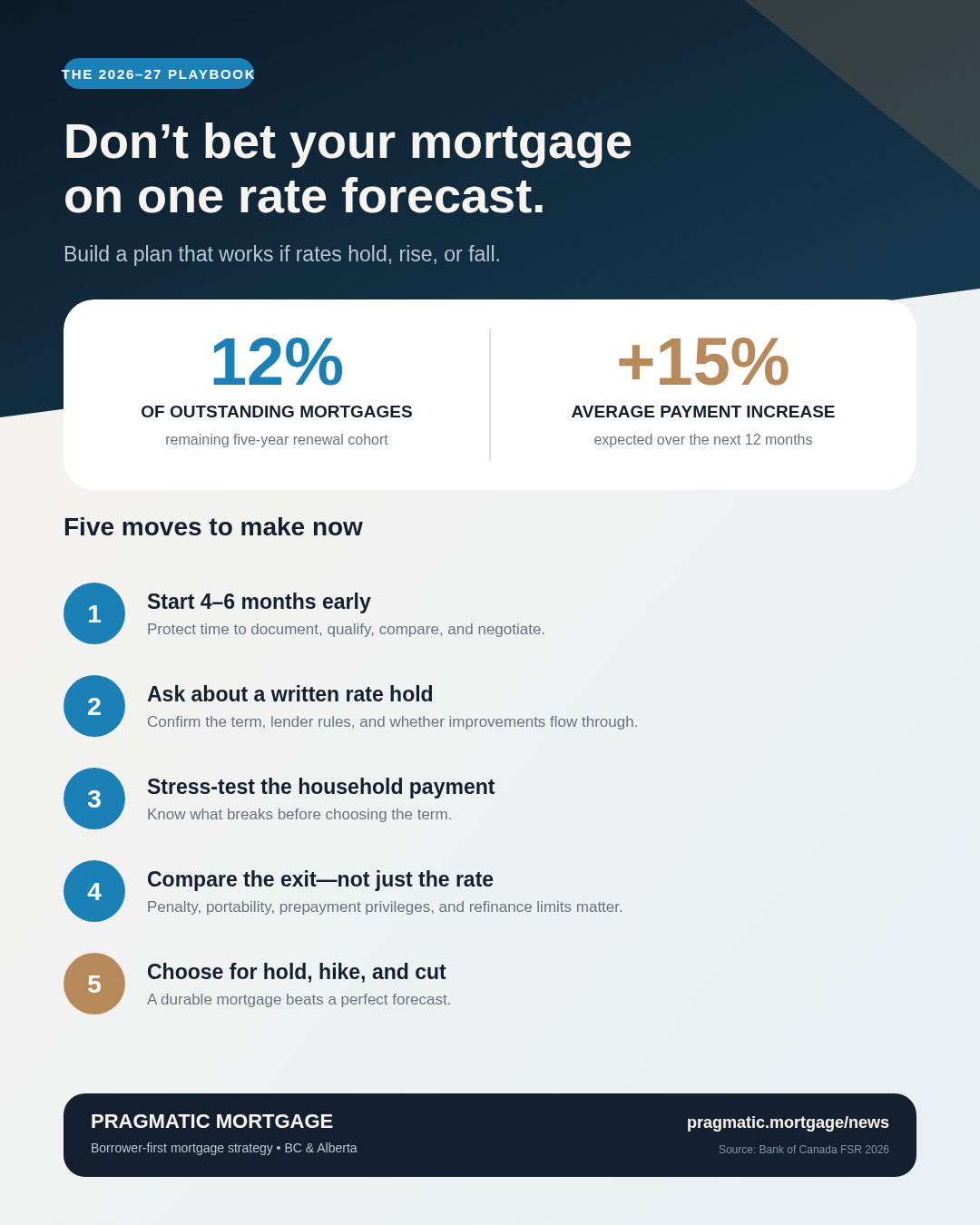
The Bank of Canada’s 2026 Financial Stability Report estimates that about 12% of outstanding Canadian mortgages will renew over the next 12 months after being taken out as five-year, fixed-payment mortgages during the low-rate period. On average, those borrowers are expected to see payments rise by about 15%.
The same report offers important context: mortgage arrears remain low overall, and more than 90% of borrowers who renewed in the prior 12 months did so below the rates at which they originally qualified. Most households are managing the transition.
But “most” is not “everyone.” A 15% payment increase can still force hard choices, especially when income has not kept pace, property values have softened, or other debt has grown.
The practical mortgage playbook now
1. Stop trying to call the exact bottom
A mortgage is not a day trade. The right term is the one your budget and life can survive—not the one that wins a hindsight contest six months later.
Choose the payment, flexibility, prepayment privileges, and exit terms first. Then compare the rate.
2. Start a renewal review four to six months early
Ask your current lender for the renewal offer, mortgage statement, remaining amortization, and payout details. Then compare that offer against other lenders before the deadline pressure starts.
Switching can take documentation and qualification work. Starting early protects your options.
3. Ask about a rate hold—but keep shopping
If you are buying, refinancing, or renewing soon, ask whether you qualify for a rate hold and how long it lasts. A hold can protect against an increase while leaving room to improve the rate if the lender’s policy allows and the market moves lower.
The exact rules vary by lender and product. Get them in writing.
4. Stress-test your own payment
Run your budget at today’s payment and at a meaningfully higher payment. A useful personal exercise is to test at one percentage point above the rate you are considering—not because that increase is forecast, but because resilience matters.
If that scenario breaks the budget, solve the cash-flow problem before choosing a term.
5. Compare the exit, not just the entrance
A low rate can become expensive if the mortgage has a harsh prepayment penalty, weak portability, limited prepayment privileges, or refinance restrictions that do not fit your plans.
Ask what happens if you sell, move provinces, separate, refinance, receive a large bonus, or convert the property to a rental. The “best” mortgage is the one that still works when life changes.
Three scenarios—and a plan for each
If the Bank holds through 2026
Variable rates may remain relatively stable, while fixed rates continue to move with bond yields and lender competition. Borrowers should compare both paths rather than assuming a policy-rate hold makes every product static.
If the next move is a hike
Variable-rate borrowers could face higher interest costs or payments, depending on the product. Borrowers renewing in 2027 may also find less relief than they expected. Payment certainty becomes more valuable—but only if the fixed product’s penalty and flexibility fit.
If inflation fades and cuts return
Variable borrowers may benefit sooner. Fixed borrowers could still win through certainty and budgeting, but may pay a premium if rates decline. That does not make the original decision wrong if it protected a household that could not absorb volatility.
The bottom line
The new signal is not that a hike is guaranteed. It is that waiting for a cut is no longer a neutral choice.
A good mortgage plan should work if rates hold, remain manageable if rates rise, and still leave you comfortable if rates fall after you lock in. That is a better standard than trying to outguess every central-bank meeting.
If your purchase, renewal, or refinance is inside the next six months, Pragmatic Mortgage Lending can compare the payment, penalty, flexibility, and lender fit—not just the headline rate.
Book a free 45-minute mortgage strategy call or start with the live Canadian mortgage rate explorer.
Frequently asked questions
Is the Bank of Canada forecasting rate hikes in 2027?
No. The July 27 release is a survey of financial-market participants, not the Bank’s own rate promise. The median participant expected 2.25% through 2026, followed by increases in 2027.
Should I choose fixed because rates might rise?
Not automatically. Fixed can protect payment certainty, but penalty formulas, portability, prepayment options, and your expected time in the property matter. Compare the full mortgage structure.
Should I wait for a lower mortgage rate before buying or renewing?
Waiting is a decision with risk on both sides. If your timing is firm, focus on affordability, obtain written options, ask about a rate hold, and choose a structure that works across several rate paths.
Do fixed mortgage rates move only when the Bank of Canada changes its rate?
No. Fixed rates are influenced more directly by bond yields, funding costs, competition, and product risk. They can change while the Bank of Canada rate stays unchanged.
Sources: Bank of Canada, Market Participants Survey—Second Quarter of 2026 (published July 27, 2026); Bank of Canada, Monetary Policy Report—July 2026 and July 15 rate decision; Bank of Canada, Financial Stability Report—2026; CMHC, Housing Market Outlook Mid-Year Update (July 22, 2026).
This article is educational and does not constitute financial, legal, or tax advice.
Rates and terms can change.
Mortgage approval is subject to lender criteria, credit review, property, income, and insurer rules.