

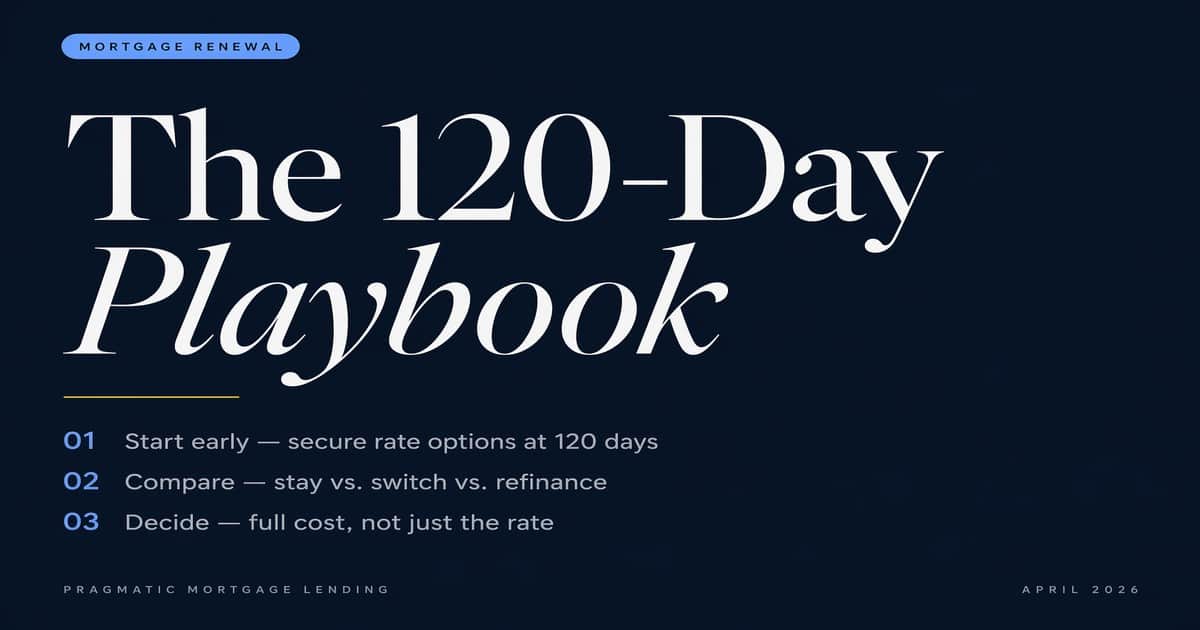
Mortgage Renewal Secrets for 2026: A Broker's Guide to Paying Less in Canada
By Pragmatic Mortgage Lending
Last updated: April 2026
Mortgage renewal used to feel like routine paperwork.
In 2026, it deserves more respect.
A large wave of Canadian borrowers is coming back to market. CMHC says more than 1.5 million households have already renewed their mortgages at higher interest rates, and another million are expected to sign new terms in the coming year.
That does not mean every renewal has to be painful.
It means the renewal has to be treated like a real financial decision — not a quick e-signature.
The goal is not simply to find the lowest advertised rate. The goal is to lower the true cost of the mortgage while protecting your flexibility, your payment, and your next move.
This guide gives you the broker's perspective on how to renew smarter, negotiate better, avoid hidden costs, and make your current lender compete before you sign.
For a personalized renew-vs-switch review, use Pragmatic's mortgage renewal strategy page before signing your lender's offer.
Quick Takeaways
| Renewal move | Why it matters |
|---|---|
| Start around 120 days before maturity | Gives you time to secure rate options, compare lenders, and keep leverage alive. |
| Do not accept the first offer automatically | Your current lender may be pricing for convenience, not your best possible outcome. |
| Compare total cost, not just rate | Legal fees, appraisal costs, discharge fees, registration costs, and penalties can change the math. |
| Ask your broker for honest advice | Sometimes switching saves money. Sometimes staying is actually the better decision. |
| Keep a fallback path alive | Your current lender negotiates differently when they know you can leave. |
| Understand switch vs. refinance | The rules, costs, documents, and qualification requirements may be different. |
The Real Secret: Renewal Savings Come From Leverage, Not Panic
Most borrowers think renewal negotiation starts when the lender sends a renewal letter.
That is too late.
The best renewal outcomes usually come from three things
- You start early enough to secure options.
- You make your current lender compete.
- You compare the full cost, not just the rate.
A lender's first renewal offer is often built around convenience.
Your current lender knows you can usually renew by signing one document. Switching lenders takes more work. There may be income documents, underwriting, property review, payout statements, title instructions, legal steps, and timing pressure.
That friction is exactly why the first offer should not be treated as the final answer.
Mortgage Professionals Canada's 2025 State of the Housing Market report found that 80% of Canadians renewed with the same lender as their previous term.
That does not mean staying is always wrong.
It means lenders know many people will choose the easiest path.
The smartest renewal strategy is not about being difficult.
It is about creating options before you need them.
1. Secure Your Rate Options at 120 Days — Not Too Soon, Not Too Late
The 120-day window is the renewal sweet spot.
Not because you must choose a mortgage four months early.
You should not.
The point is to secure options while you still have leverage.
Many Canadian lenders allow rate holds or mortgage commitments around the 90-to-120-day range. Exact rules vary by lender, product, approval status, and whether you are renewing, switching, or refinancing.
Why the 120-Day Window Matters
Fixed mortgage rates in Canada are heavily influenced by the bond market.
Banks and mortgage lenders often use Government of Canada bond yields as a benchmark for fixed-rate mortgage pricing.
When bond yields rise, lenders' funding costs can rise, and fixed mortgage rates may move up.
When bond yields fall, fixed pricing can improve.
That means a borrower who waits too long may lose access to a rate that was available earlier in the window.
A rate hold is protection.
It is not a prison.
A good broker should lock in a strong available option around the 120-day mark and continue watching the market. If rates rise, you have protection. If rates fall before maturity, the broker should be pushing for the lower available option where the lender allows it.
The professional move is not
"Lock it and forget it."
The professional move is
"Lock it, monitor it, and improve it if possible."
120-Day Renewal Timeline
| Timing before maturity | What to do | Why it matters |
|---|---|---|
| 130 days out | Collect your mortgage details | You need your balance, maturity date, payment, term, prepayment rules, and lender offer history. |
| 120 days out | Secure rate options | This protects you if fixed rates rise during your renewal window. |
| 90 days out | Compare current lender vs. switch lender | This is where the real renew-vs-switch math begins. |
| 60 days out | Pressure your current lender with real numbers | A written competing option gives your current lender a reason to improve. |
| 30 days out | Finalize the winning path | You still have enough time to manage documents, legal steps, and closing details. |
| 10 days out | Confirm payout, legal, payment, and fee details | This helps avoid last-minute surprises. |
More than 120 days out, many switch options are not yet actionable.
Less than 120 days out, you may still be fine, but you have less room for underwriting, legal work, lender delays, appraisal issues, or a current-lender counteroffer.
2. Do Not Accept the First Offer Just Because It Is Easy
Your current lender's renewal offer is often the convenience offer.
That does not mean the lender is doing anything wrong.
It means they are pricing a borrower who is likely to stay.
With your existing lender, the renewal process can be simple
- Review the offer.
- Choose a term.
- E-sign.
- Done.
There may be little or no income verification, no new appraisal, no new legal process, and no moving parts.
Switching lenders is different.
The new lender usually needs to approve the file. They may ask for income documents, property details, mortgage statements, payout information, identification, and sometimes an appraisal or legal work.
That inconvenience is why many borrowers renew without testing the market.
But convenience is not always the cheapest path.
First Offer vs. Competitive Renewal Strategy
| If you accept the first offer | If you compare properly |
|---|---|
| Fast and easy | Takes more effort, but creates leverage |
| Usually minimal paperwork | May require documents and underwriting |
| Current lender controls the pace | You control the comparison |
| May miss lower-cost options | Broker can compare current lender, switch lender, and refinance paths |
| Often focused on rate only | Looks at rate, fees, penalties, flexibility, and future plans |
| Convenient today | Potentially cheaper and smarter over the full term |
Before signing, ask your current lender
"Is this your best renewal rate, or the standard renewal offer?"
"Can you send the rate, term, prepayment privileges, portability, penalty method, and fees in writing?"
"I am comparing this against another lender. If I stay, what is your strongest final offer?"
"Are there any restrictions, auto-renewal terms, or fees I should know about?"
A serious renewal conversation should happen in writing.
Phone promises are not final terms.
3. Ask Your Broker for Honesty, Not Just a Lower Rate
A good broker does not always tell you to switch.
Sometimes staying with your current lender is the right answer.
That can happen when
- Your lender's final retention offer is genuinely competitive.
- The switch savings are too small to justify the hassle.
- Legal or collateral-charge costs eat the benefit.
- Your current lender has better features for your next move.
- The new lender's rate is better, but the mortgage is less flexible.
- Your timeline is too tight to move cleanly.
- The file is better suited to a refinance, not a straight switch.
Mortgage pricing also changes quickly.
One lender may be aggressive this week and uncompetitive next week. Another lender may have a promotion, a funding target, a product niche, or a temporary pricing advantage.
A broker sees more of that market than a single lender usually will.
The honest answer should sound like this
| Broker should show you | Why it matters |
|---|---|
| What staying costs | Gives you the true current-lender baseline. |
| What switching costs | Shows whether moving lenders is worth the effort. |
| What refinancing costs | Helps determine whether the real problem is payment, debt, cash flow, or structure. |
| Interest difference over the term | Prevents the decision from being based only on monthly payment. |
| Legal, discharge, appraisal, and registration costs | Reveals whether the lower rate still wins after fees. |
| Feature differences | Protects you if you sell, refinance, prepay, or break early. |
| Recommendation to stay or move | You need the broker's honest judgment, not just a rate quote. |
If your broker cannot explain why one option wins after fees and features, you do not have a complete comparison yet.
4. Do Not Waste Everyone's Time — Run One Clean Negotiation Loop
The fastest way to renewal clarity is simple.
Ask your broker for the best real option you are likely to qualify for.
Then take that option back to your current lender and ask whether they can match or beat it.
If they can match it, staying may be easier.
If they cannot, ask your broker to calculate the actual savings from switching.
Do not compare only the payment.
Compare the full cost.
Renewal Comparison Formula
Net renewal benefit =
interest saved
+ lender credits
− switch costs
− value of lost flexibility
For example, saving 0.10% may not be worth switching if the balance is small, the fees are high, or the new mortgage is less flexible.
Saving 0.30% to 0.50% on a larger balance may be very worth it, especially if the new lender covers most transfer costs and the mortgage features are comparable.
The question is not
"Can I get a lower rate?"
The question is
"Does moving lenders leave me better off after all costs and risks?"
What to Compare Before You Decide
| Comparison point | Why it matters |
|---|---|
| Interest paid over the term | Shows the real cost of the rate difference. |
| Monthly payment | Important for cash flow, but not the whole decision. |
| Legal or transfer costs | Can reduce or erase the benefit of switching. |
| Appraisal cost | Some lenders require one, some do not. |
| Discharge or registration fees | Your current lender may charge fees to leave. |
| Lender cash-back or fee coverage | Can improve the switch math. |
| Prepayment privileges | Important if you plan to pay the mortgage down faster. |
| Penalty method | Crucial if you might break the mortgage before maturity. |
| Portability | Important if you might move before the term ends. |
| Collateral-charge friction | May add extra legal steps or costs. |
| Time and paperwork | The cheapest option is not always worth it if the savings are tiny. |
5. Find the Hidden Costs Before the "Better Rate" Seduces You
A lower rate can lose once the fee stack appears.
Before you commit, ask what the switch actually costs.
FCAC advises borrowers to ask about costs when changing lenders, including setup fees, discharge fees, registration fees, transfer or assignment fees, appraisal fees, and other administration fees.
Some lenders cover certain switch costs.
Some do not.
Some cover them only under specific conditions.
Some costs may still fall on you.
Hidden Renewal and Switching Costs
| Cost or issue | What to ask |
|---|---|
| Legal or title costs | Will the new lender cover legal or title work? |
| Appraisal fee | Is an appraisal required, and who pays for it? |
| Discharge fee | Does the current lender charge a discharge or admin fee? |
| Registration fee | Are there land title or registration costs? |
| Transfer or assignment fee | Can the mortgage be transferred cleanly, or does it require extra steps? |
| Collateral charge | Is the current mortgage a collateral charge, and does that increase legal work? |
| Cash-back clawback | Will the old lender recover any cash-back incentive if you leave? |
| Title insurance | Is new title insurance required? |
| Property tax setup | Will taxes be handled the same way? |
| Payment timing | Will the payment date or frequency change? |
| Interest adjustment | Will there be per-diem interest at closing? |
Collateral charges deserve special attention.
If your mortgage is registered as a collateral charge, switching lenders can sometimes involve extra legal steps or costs compared with a standard charge.
This is one of the easiest ways for a "great rate" to become an average deal.
The right comparison is not lender rate vs. lender rate.
It is current lender total cost vs. new lender total cost.
6. Know the Difference Between a Straight Switch and a Refinance
This is crucial in 2026.
A straight switch generally means moving the mortgage to a new lender at renewal without increasing the loan amount or extending the remaining amortization.
A refinance means changing the mortgage more materially.
That could include
- Increasing the mortgage amount.
- Extending the amortization.
- Consolidating debt.
- Changing the mortgage structure.
- Accessing home equity.
- Adding or removing borrowers.
- Changing the charge or security structure.
Those are not the same transaction.
The difference matters because qualification, stress testing, lender options, costs, and timelines can change depending on whether the file is treated as a switch or a refinance.
OSFI's straight-switch rule change for uninsured mortgages applies only when transferring the mortgage at renewal without increasing the loan amount or extending the amortization.
That is helpful for competition, but it is not a free-for-all.
The broker question is simple
"Is my file a straight switch, or is it a refinance?"
That answer can change everything.
Straight Switch vs. Refinance
| Path | What it usually means | Best when | Watch for |
|---|---|---|---|
| Renew with current lender | You stay with your lender for a new term. | Their revised offer is competitive and features are acceptable. | First offer may not be their best offer. |
| Straight switch | You move the existing mortgage to a new lender at renewal. | Another lender has a better all-in offer and the mortgage structure is not changing. | Legal costs, collateral charge, qualification, documents, and timing. |
| Refinance | You change the mortgage amount, amortization, or structure. | You need equity access, debt consolidation, lower payment, or a new structure. | More underwriting, possible stress test impact, higher total interest, and additional costs. |
Do not let these paths get blurred.
They solve different problems.
7. If Your Mortgage Is Insured, Do Not Accidentally Pay Insurance Twice
If you bought with less than 20% down, your mortgage may be insured.
That insurance can matter at renewal.
If you already have mortgage loan insurance, tell the new lender and your broker before a switch is arranged. In many cases, the existing insurance status may help with pricing or transfer options.
But if you increase the loan amount, extend amortization, or materially change the mortgage, the insurance treatment can change.
Ask your current lender for the insurance certificate number.
Then ask the new lender
- Can this be switched as an insured transfer?
- Will any new insurance premium apply?
- Does changing the amortization trigger a premium?
- Does increasing the mortgage amount change the insurance treatment?
- Will the rate be priced as insured, insurable, or uninsured?
This is not a small detail.
It can change the entire economics of the renewal.
8. Choose the Term Based on Your Life, Not Just the Lowest Rate
The lowest rate is not always the best mortgage.
A five-year fixed rate may look attractive, but if you expect to sell in 18 months, the penalty risk could matter more than the rate.
A shorter fixed term may cost more today but preserve optionality.
A variable rate may offer flexibility and potential savings, but it brings payment or rate uncertainty, depending on the product.
Your renewal term should match your plan.
Term Selection Questions
| Question | Why it matters |
|---|---|
| Will I sell during this term? | Portability and penalty risk may matter more than rate. |
| Will I refinance for renovations or debt restructuring? | A restrictive product could become expensive. |
| Will I make lump-sum prepayments? | Prepayment privileges can matter more than a tiny rate difference. |
| Will I need portability if I move? | Not all portability features are equal. |
| Do I need payment certainty? | Fixed may suit risk-sensitive borrowers better. |
| Could my income change? | Flexibility and payment stability may matter. |
| Am I trying to lower payment or lower total interest? | Those are not always the same goal. |
| Is this mortgage likely to last the full term? | Break penalties become more important if the answer is no. |
Fixed and variable products are influenced by different forces.
Fixed rates are linked more closely to bond-market pricing.
Variable mortgage rates are tied to lender prime rates, which are influenced by the Bank of Canada's policy rate.
A renewal is not a bet on a headline.
It is a financing decision for the next chapter of your life.
9. Protect the Features That Become Expensive When Life Changes
Borrowers often obsess over rate and ignore features.
That is backwards.
The features are what matter when life changes mid-term.
Review these before you sign
| Feature | Why it matters |
|---|---|
| Prepayment privileges | Determines how much extra you can pay without penalty. |
| Double-up payment options | Helps accelerate payoff if cash flow allows. |
| Annual lump-sum limits | Important if you expect bonuses, business income, or asset sales. |
| Portability rules | Matters if you might move. |
| Blend-and-extend rules | Can affect future flexibility. |
| Penalty calculation method | Crucial if you break early. |
| Fixed-rate IRD exposure | Some fixed penalties can be expensive. |
| Variable-rate penalty | Often simpler, but still needs confirmation. |
| Standard vs. collateral charge | Can affect switching and legal costs. |
| Cash-back clawbacks | Some incentives may need to be repaid if you leave early. |
| Bonafide sale clauses | Can restrict your ability to break unless the property is sold. |
| Refinance restrictions | Some products limit your options mid-term. |
| Early payout restrictions | Some low-rate products come with strings attached. |
A 0.05% lower rate with poor flexibility may not be better.
If you are certain you will keep the mortgage for the full term, features may matter less.
If you might sell, refinance, prepay, separate, move cities, renovate, or access equity, features matter a lot.
A broker should help you price those risks before you sign.
10. Do Not Blindly Extend Amortization to Make the Payment Look Better
A longer amortization can lower the monthly payment.
It can also increase total interest cost.
That does not mean extending amortization is always wrong.
Sometimes cash flow is the priority. Sometimes a household needs breathing room. Sometimes a refinance is part of a broader debt plan.
But do not pretend it is free.
Ask your broker to show
| Scenario | What to compare |
|---|---|
| Current amortization | Payment, interest over term, and total remaining interest. |
| Extended amortization | Lower payment, but higher long-term cost. |
| Refinance with debt consolidation | Whether total household cash flow improves enough to justify the structure. |
| Prepayment strategy | Whether extra payments can offset the longer amortization. |
| Shorter term vs. longer term | Whether flexibility or payment stability matters more. |
Lower payment is not always lower cost.
A renewal should not only answer
"Can I make the monthly payment?"
It should also answer
"What is this decision costing me over time?"
11. Use the Renewal Statement — But Do Not Wait for It
Your lender's renewal statement is useful.
But it should not be the start of your process.
Federally regulated lenders must provide a renewal statement at least 21 days before the end of the existing term.
That is helpful.
But 21 days is not a renewal strategy.
By the time the official renewal statement arrives, you should already know
- What your current lender is offering.
- What outside lenders can offer.
- Whether you qualify to switch.
- Whether any fees apply.
- Whether staying or moving is cheaper.
- Whether refinancing should be considered.
- What documents are still needed.
- What your final decision deadline is.
Do not let the renewal statement start the process.
Let it confirm the process.
If the first time you seriously review your mortgage is when the renewal letter arrives, you may already be negotiating from a weaker position.
12. Broker Scripts You Can Use With Your Lender
Use simple, direct language.
First request
My mortgage matures on [date]. Please send your strongest renewal offer in writing, including the rate, term, payment, prepayment privileges, portability terms, penalty calculation method, and any fees.
Competing offer request
I am comparing this with another lender. If I stay, I need your best final offer in writing, including any retention discount or fee concession.
Fee confirmation
Before I sign, please confirm whether there are any renewal fees, discharge fees, registration costs, legal costs, admin costs, cash-back clawbacks, or restrictions that would affect me if I sell, switch, refinance, or break the mortgage.
Feature confirmation
Please confirm the prepayment privileges, portability terms, penalty method, collateral-charge status, and any restrictions on refinancing or early payout.
A good lender should be able to answer clearly.
A good broker should help you interpret the answer.
13. The 2026 Mortgage Renewal Checklist
Before you compare anything, gather the basics.
| Item | Why it matters |
|---|---|
| Current mortgage statement | Confirms the balance, lender, and payment details. |
| Maturity date | Determines your timeline. |
| Current balance | Needed to compare rate and interest cost. |
| Current lender renewal offer | Creates the baseline. |
| Current payment amount and frequency | Helps compare cash flow. |
| Remaining amortization | Determines whether the file is a switch or refinance. |
| Property address and estimated value | Needed for lender fit and loan-to-value. |
| Standard or collateral charge details | May affect switching costs. |
| Mortgage insurance certificate, if insured | Helps avoid confusion on insured transfer options. |
| Prepayment privileges | Important for flexibility. |
| Penalty method | Important if you might break the mortgage early. |
| Property tax details | Some lenders handle taxes differently. |
| Condo or strata fee details, if applicable | Needed for qualification. |
| Income documents | Often required if switching or refinancing. |
| List of debts | Needed if considering refinance or debt consolidation. |
| Your next-move plan | Determines whether rate, payment, flexibility, or structure matters most. |
The better the file, the better the advice.
A broker does not need perfection on day one.
But they do need enough information to compare your options properly.
14. Red Flags Before You Sign
Be careful if
| Red flag | Why it matters |
|---|---|
| The offer is verbal only | Phone promises are not final terms. |
| Only the rate is discussed | Features, fees, and penalties may matter more later. |
| No one can explain the penalty method | That can become expensive if life changes. |
| The "no cost switch" has no written fee breakdown | Some costs may still fall on you. |
| The broker cannot explain why the lender is the best fit | A rate quote is not the same as advice. |
| The current lender will not provide details in writing | You need the full offer before signing. |
| You are told to renew early without comparing the cost | Early renewal can be useful, but it can also give up value. |
| The lower-rate option removes features you need | Cheap can become expensive if flexibility disappears. |
| The refinance lowers payment but dramatically increases interest | Cash-flow relief should be compared against long-term cost. |
| The process feels rushed | A rushed renewal usually means leverage was lost earlier. |
A mortgage renewal should feel calm by the time you sign.
If it feels rushed, the process started too late.
Renew, Switch, or Refinance: Simple Decision Table
| Your situation | Usually worth considering |
|---|---|
| Current lender matches or beats the market and features are strong | Renew with current lender |
| New lender saves meaningful interest after all fees | Straight switch |
| You need to access equity | Refinance |
| You need to consolidate debt | Refinance |
| You may sell soon | Shorter term, portable mortgage, or more flexible product |
| You want maximum payment certainty | Fixed-rate options |
| You want flexibility and can tolerate rate movement | Variable-rate options |
| The switch savings are tiny | Staying may be better |
| Your current lender refuses to compete | Broker-led switch comparison |
| You are unsure what life looks like in two years | Avoid locking into the wrong structure just for a slightly lower rate |
Bottom Line: The Lowest-Cost Renewal Is Usually the Best-Prepared Renewal
The best renewal decision is not always switching.
It is not always staying.
It is not always fixed.
It is not always variable.
The best decision is the one that still makes sense after rate, fees, flexibility, qualification, timing, and your next life move are all on the table.
Start around 120 days before maturity.
Secure rate options.
Make your current lender compete.
Ask your broker for the honest math.
Compare the full cost.
Then sign only when the winning path is clear.
For a personalized renewal comparison, visit Pragmatic's mortgage renewal strategy page and pressure-test your options before the default offer writes the story for you.
Frequently Asked Questions About Mortgage Renewal in Canada
When should I start my mortgage renewal?
Start around 120 days before maturity. That usually gives enough time to secure rate options, compare lenders, prepare documents, and keep a switch path alive.
Should I accept my current lender's first renewal offer?
Not automatically. Your current lender's first offer may be convenient, but it is not always the best offer. Compare the full cost before signing.
Can a broker get me a better renewal rate?
Sometimes, yes. A broker may find a better lender option or help you use a competing offer to negotiate with your current lender. But a good broker should also tell you when staying is the better decision.
Is switching lenders at renewal worth it?
It depends on the savings after fees, the mortgage features, the legal process, and your future plans. A lower rate is only better if the full package leaves you ahead.
What is the difference between renewal and refinance?
Renewal is simply starting a new term with your current mortgage. Refinancing changes the mortgage more materially, such as the amount, amortization, or structure.