TL;DR

The strongest pre-approvals combine verified income, documented down payment, and stable debt behavior. If your file changes after pre-approval, your final approval can change too.

Pre-qualification vs pre-approval vs final approval

Stage What it does What it does not do
Pre-qualification Early estimate using high-level inputs. Does not confirm full lender underwriting.
Pre-approval Stronger lender review of credit, income, and debts; may include rate-hold terms. Does not guarantee funding for every property or unchanged borrower profile.
Final approval Complete underwriting with property and condition sign-off. Cannot be assumed from pre-approval alone.

FCAC guidance emphasizes this distinction: treat pre-approval as readiness, then execute carefully through underwriting and closing.

What lenders usually verify during pre-approval

Most lenders evaluate your file through four lenses

  • Income quality and continuity.
  • Debt-service capacity under stress assumptions.
  • Credit history and current liabilities.
  • Down payment source and account history.

For many borrowers, qualifying math includes the mortgage stress test at the greater of contract rate + 2% or the benchmark floor set by OSFI for uninsured mortgages.

Document stack that prevents underwriting delays

Incomplete files are the main reason pre-approvals stall later. Submit a clean package once:

  • Government photo ID and legal name consistency.
  • Employment and income evidence matching your borrower type.
  • Current liability snapshot and recent account statements.
  • Down payment evidence with gift letters or large-deposit explanations when needed.
Underwriters are faster when your evidence is complete, consistent, and easy to read.

How to use pre-approval when you make an offer

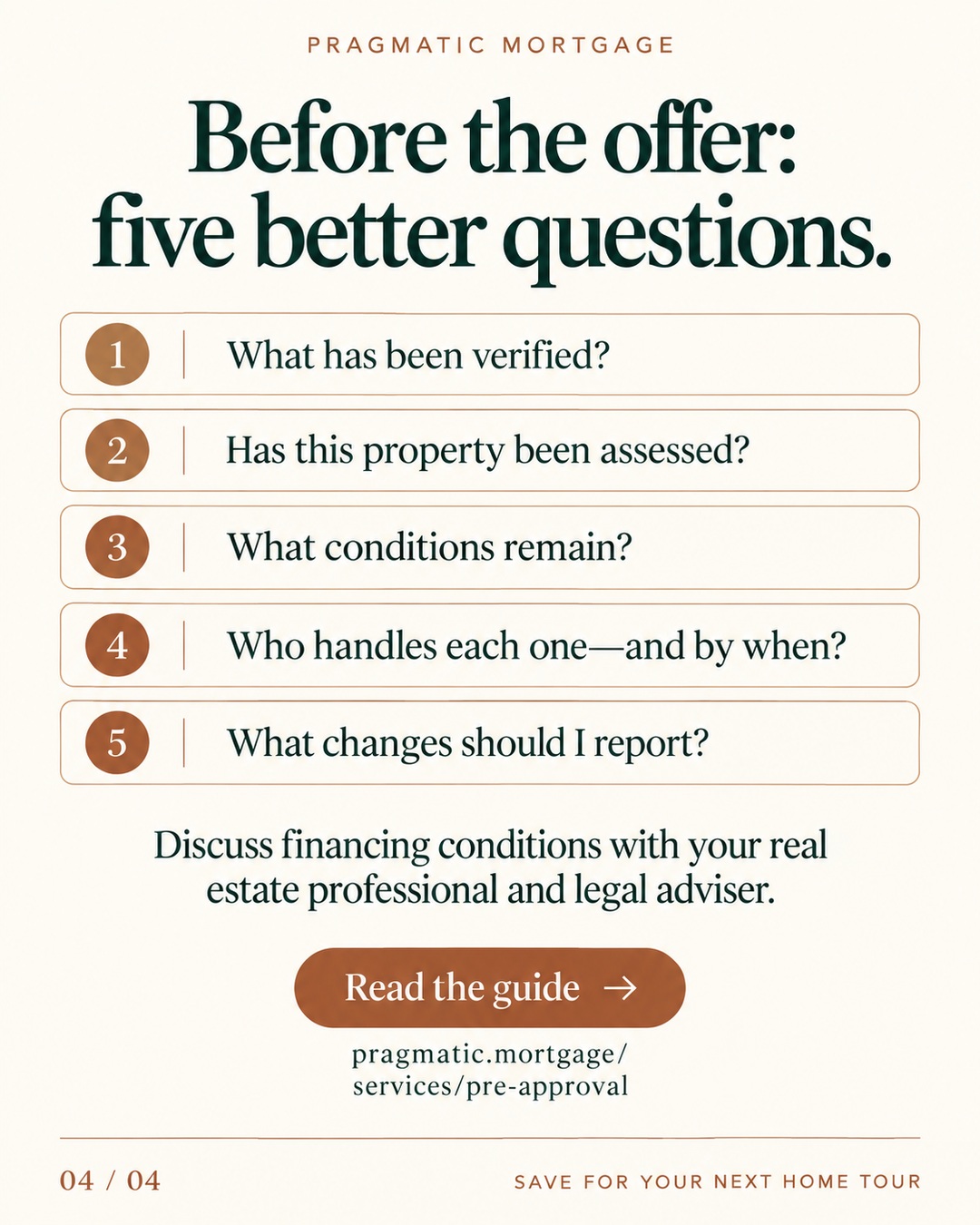
Match your financing condition timeline to your lender's real turnaround time. Overly aggressive dates create avoidable risk.

After an accepted offer, your file still moves through appraisal, insurer/lender checks where applicable, and condition sign-off before funding.

mortgage pre-approval checklist in Canada planning discussion for Canadian borrowers
Pre-approval is step one. Funding certainty comes from clean offer-stage execution.

Common reasons pre-approved files are declined later

  • New debt added after pre-approval (car loan, credit line, financed furniture).
  • Income change that weakens debt-service ratios.
  • Unclear source of funds or unexplained deposits.
  • Property issues found during appraisal or lender review.
  • Missing or inconsistent documents near closing.

Rule: once pre-approved, keep the file stable until funding.

30-day pre-approval readiness sprint

  1. Week 1: gather ID, income docs, debt list, and down payment evidence.
  2. Week 2: clean credit/report issues and reduce high-utilization balances.
  3. Week 3: run affordability and stress-test scenarios with realistic buffers.
  4. Week 4: lock your offer range and confirm lender turnaround expectations.

Decision traps to avoid

  • Overconfidence bias: treating pre-approval as guaranteed funding.
  • Present bias: prioritizing speed over document quality.
  • Loss aversion: waiving financing conditions before risk checks are complete.

Counter-move: use one lender scorecard for every option: approval certainty, total cost, timeline reliability, and contract flexibility.

Best next step

Before shopping seriously, finalize your lender-ready checklist and your maximum comfortable payment. Then map offer timelines to lender operations, not guesswork.

Visual guide

mortgage pre-approval checklist in Canada documents and calculator in warm sunset light
Pre-approval to offer-to-funding workflow for Canadian home buyers